











Some time ago, I wrote an article on poetry—mostly as an excuse to share a few poems I’d written. Luckily the piece doubled as a chance to share some general thoughts on the philosophy of writing. The Viking Vibe has not published fiction to the extent I wished for with that original article, so here I go again. You don’t need to have read that article to understand this one.
Just as with the other article, I will share some of my own creative writing work. That is in a second Viking Vibe article this piece is twinned with.
…
I’m sort of “vanilla,” in that I have far more writing pet peeves than the average person. Here are just a few:
- Most fantasy novels
- Most dystopian novels
- Particularly gushy romance
- “Instagram poetry,” especially when it very clearly only serves as a way for the author to vent.
- Book series.
- Dialogue that attempts to sound antiquated but comes off as meaninglessly clunky
- Excessive grossness, sex, or profanity only for shock value
- Prose that is pretty for no reason other than to be pretty and for the author to show off
- Poetry that is clearly only about the author—especially if they use “you” and “I” pronouns too much—or author worship.
- Use of italics to represent thoughts, excessive use of italics, or italicizing the same phrase numerous times in a piece without developing said phrase at all
- Stock characters
- Imprecise verbiage, or verbiage that repeats excessively and does not become any more precise in doing so
- “Perfect lines” in a piece, or worship thereof.
- People who follow the above rules and others (including the comically overstated “show not tell” or “don’t say say”) so religiously that they refuse to take chances with writing, and thus develop stocky stories.
…
I will not elaborate on these—both because most are self-explanatory, and because all are matters of taste. I don’t expect you to agree with me on all of these—and in fact some works execute these traits very well.
Notice however that most of these tend to “stick together.” Authors who don’t care about the quality of their prose as a whole are probably far more likely to depend on perfect lines, or to try and make a story interesting through inspiring disgust in the reader. Sourya, who doesn’t like stock characters or book series, is likely to also dislike fantasy novels—and he does so, because he associates those types of stories with the prose characteristics he dislikes.
I really like realism in fiction. I don’t literally mean stories that can happen in the real world, more the general idea of a story that flows as one would expect. Good fiction should have a strong theme that reflects something back to the real world, and everything in a piece—plot, characters, etc.—should be an extension of that.
You’ll notice that “stickiness” comes back if we examine the list in terms of realism. Excessive grossness is only excessive because it feels as if it’s much beyond the limits of real life; if the hand of the author can be noticed in a novel—as is the case when there are stock characters who don’t represent reality, or for the reader cringely-tangible authorial self-satisfaction after a perfect line—that does not reflect back on reality. It cannot reflect back on the nature of reality because it instead reflects back only on the author, creating a feeling of awkward simplicity. That then can be extended to explain why “I, you, me” poetry feels bizarre.
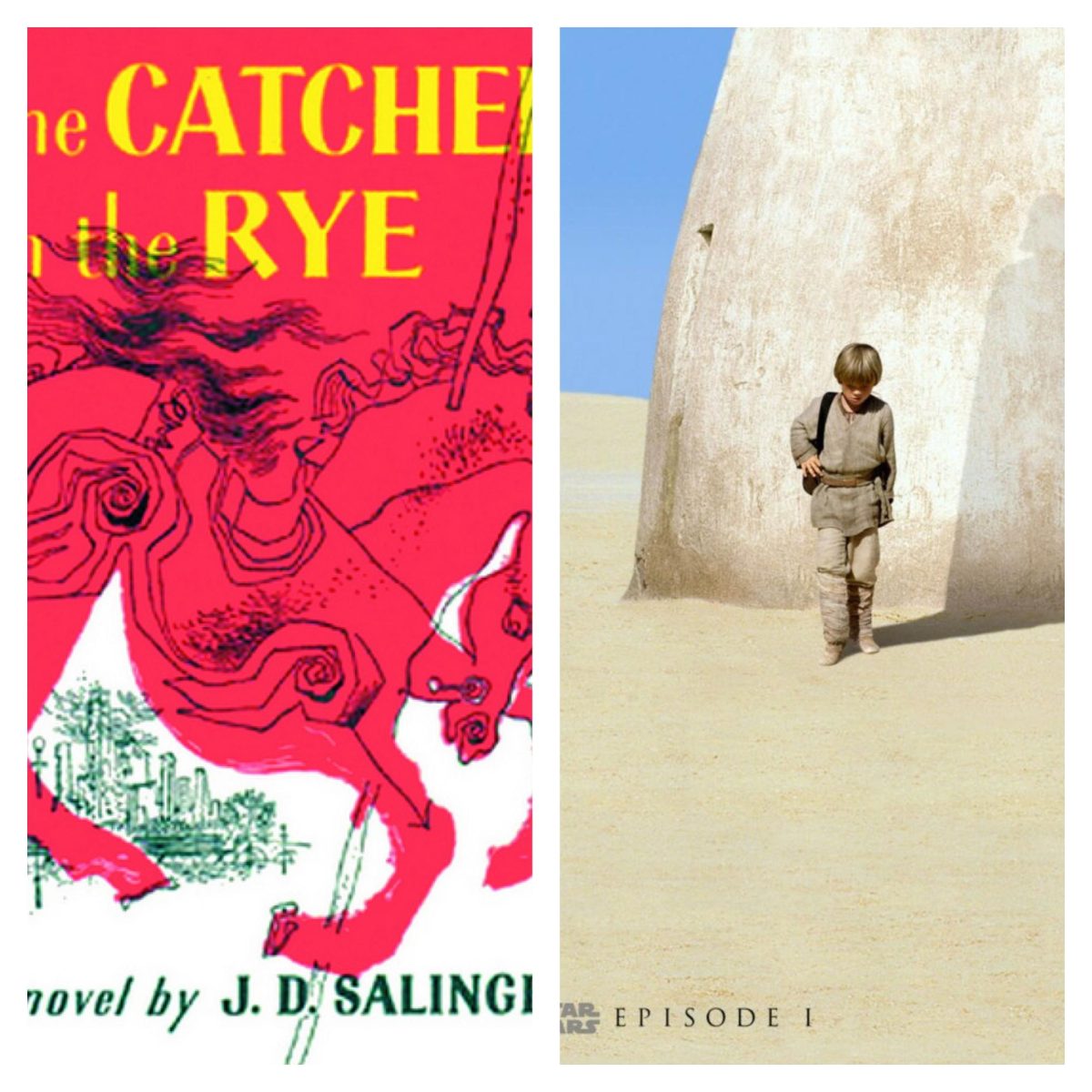
Despite popular consensus, I really like the Star Wars prequels. This may seem a little weird, because the whole thing is a fantasy series—one very well known especially for clunky dialogue—but Star Wars does some things very well. I especially liked the political subplot and corruption therein, which—if you’ll notice—reflects back on our very own political systems, while still providing interesting world-building in the process. I cannot care about characters if I cannot see some element of me—or any other human I know—in them. Good writing is psychological. Anakin’s emotions and passion (and even his wacky lines at times) are greatly amplified in the fiction, but fundamentally they represent real suffering and development that on a lesser scale affects real people.
In short: the sort of realistic writing I like makes things that happen in fiction feel as if they could happen in real life, and the things of real life feel as if they could happen in fiction. As if you could find your best friend in a fictional world and could imagine a fictional character to be a person you really know. Real life is complex—if fiction is too cookie-cutter, it creates a nasty sense that what you’re reading is useless. Good realistic fiction is in no way less “creative” than world-writing. Writing a good story that entertains, that says things, that feels high quality in our own world demonstrates a very high level of control and maturity; it creates necessary complexity that makes the reader feel they are doing something worthwhile.
A key indicator for realistic writing is that the mood created by the prose—that precise prose—is so omnipresent that even if the piece can be analyzed, it still feels as if you’re watching a reflection. Something like The Catcher in the Rye can make an impact on the reader even if they don’t fully comprehend the theme of innocence in words. A reader can immediately tell that the young Phoebe is different from all the other characters Holden Caulfield deals with, that Holden reacts to her differently—despite no paragraph discussing how Phoebe on the cyclical carousel represents the cyclical nature of life or whatever else. That’s the greatest benefit of fiction: that it can express human emotions and experiences beyond the most literal words on the page. That a person can write to express feelings, and why humans feel them, in a form more “eminent,” more “elevated” than an essay. That the work can be examined in such a way that it goes on beyond the author’s capabilities to state the problem and solution. The final sign of great prose is that it cannot be simplified any further because to do so would kill the integrity of the project.
Now—for the written piece I promised. It’s a few page-long monologue, centering around subjects of mundanity, escape, and especially hypocrisy. The story depends heavily on irony and subtext, but you should not need to analyze it to get the gist. Please do read and enjoy “Rocks.”