














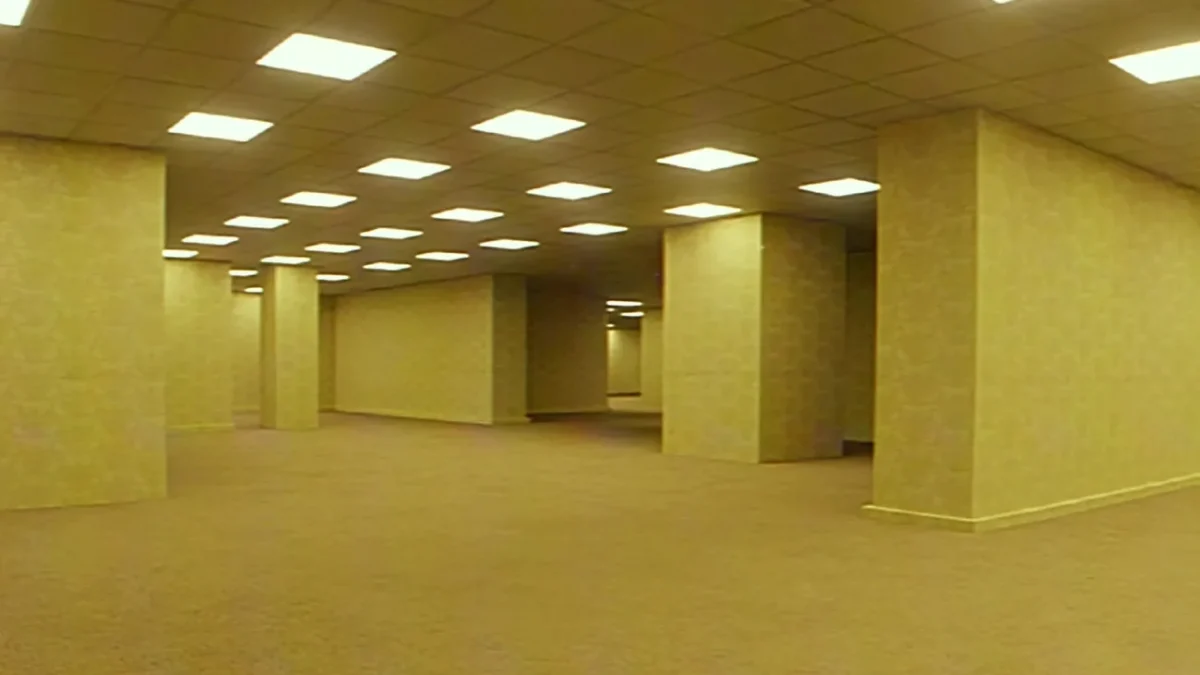
The Backrooms, in the 2019 4chan post they originated from, were described as “approximately six hundred million square miles of randomly segmented empty rooms to be trapped in.” The post, accompanied by a corresponding image, describes the simple yellow wallpapers, dull and moist carpets, and fluorescent lighting that characterize this imagined horror concept. To close off the post, a warning to those who “noclip” (a video-gaming term used to describe glitches that phase an avatar through solid barriers) into the Backrooms is given to readers, advising them to stay away from a mysterious and potentially dangerous creature within the Backrooms.
From this information alone, it is clear that the origins of the Backrooms as a “creepypasta”—a frequently reposted/copy-and-pasted horror story on the internet—are rooted deeply in the culture of video games and the internet, and much outside the realm of film. Luckily, I have followed the development of the Backrooms since before the film went into production, and now understand just how significant Backrooms (2026) is for Hollywood and the internet.
Of course, the original photo was simply taken in an empty Wisconsin warehouse, but when the internet gets its hands on something fun and original, it only continues to grow. After the original post, “Backrooms” fans were divided into three sectors: the first were those who lingered on the final warning of the post, finding themselves invested in whatever this undescribed creature might be. The second were the creative inventors of “levels” to the Backrooms, with each next level representing another familiar location, like an empty pool or a playground. These fans were similar to those of the SCP Foundation, in the sense that anyone with access to posting on the internet could contribute to an ever-growing database of fun horror concepts. The third and final group were what I like to call the “traditionalists” of the Backrooms, who outright rejected the idea of creatures in the Backrooms and argued that the true horror of the Backrooms is their inescapability; those who are trapped within them are left with only a sense of what life used to be like through vague feelings of eerie familiarity.
Each one of these groups had its merits, but a thesis for the Backrooms as a concept already began to emerge. Backrooms fans had invented a situation in which all of these empty rooms and locations conformed to similar styles, creating a sense of confusion and ultimately sadness with the loss of architectural individuality. Its inescapability details a real-world problem with trends in modern architecture involving an overall loss of culture that is reflected by the physical spaces in our world.
Despite this shared motivation, these groups of Backrooms fans often found themselves fighting, usually with the “traditionalists” who wanted the Backrooms to represent a type of “liminal horror” that strayed from conventional horror trends, especially those that had ruled Hollywood. As easy as it would be to villainize this group for attacking other Backrooms fans, they absolutely had a point about the originality of this idea and the importance of preserving it. Horror had grown into a genre of film that followed basic slasher formulas and only tried to “outdo” themselves with more blood, gore, and shock value. The Backrooms, and liminal horror in general, were entirely original and created by people who truly cared about what they wrote.
The first “liminal horror” film I had seen done correctly was It Ends (2025), directed by 28-year-old Alexander Ullom. The film follows a group of college-aged students who find themselves on an infinite road to nowhere. Rather than inserting some kind of horror creature that’s out to get them, the film’s conflict centers around the characters’ motivation to keep going and their fight against the temptations of nihilism. It Ends is extremely profound and existential, all while following a young and diverse cast of Gen Z characters who speak very realistically for their ages. Ullom’s age in particular is notable because this film, in my eyes, represents the opening of the gateways for younger horror directors, bringing internet culture to Hollywood.
In 2022, Kane Parsons, or Kane Pixels on YouTube, released a nine-minute “Backrooms” short film, created almost entirely in Blender. At the time, he was sixteen years old. Although Parsons did not invent the concept, the internet loved seeing a short film about the Backrooms since there were no restrictions regarding who could create art based on a creepypasta. At this point, Backrooms games and art projects were already being worked on and published, but the short film really brought the idea to life. In fact, the video went so viral that it grew past simply reaching reaction YouTubers and caught the attention of mainstream distribution company A24.
At just seventeen, Parsons was being consulted by Hollywood executives regarding his short film, which I’m definitely not jealous of. With a budget of under $10 million, he spent his late teens directing a full-length feature version of Backrooms, starring award-winning actors Chiwetel Ejiofor and Renate Reinsve. At just twenty years old, Parsons made A24 its highest-grossing film of all time, collecting over $272 million in the box office.
Backrooms’ success, aside from the obvious benefits of future opportunities for young directors and original films, represents a shift in creative freedom caused by the prevalence of internet culture. It took me until this point just to describe the significance of the Backrooms to the internet, and I can imagine that for older A24 executives, this wasn’t the easiest topic to understand. Something about the Backrooms worked for the internet, and only young people like Kane Parsons understood what made it work. While A24 has been known to be one of the more lenient production/distribution companies, the classic “Hollywood studio disrupts creative vision of young director” tale was impossible anyway, since only those in close connection to the culture of the internet truly understood its significance and what it meant. Hopefully, internet culture has been the catalyst to a trend of full directorial freedoms being retained in future Hollywood productions.
I would not consider Backrooms to be an example of liminal horror. That being said, I really liked the film for what it was. Parsons’ version of the Backrooms has been consistent across the short and feature film: the rooms repeat themselves infinitely by trying (and often failing) to replicate or “remember” the real world; the rooms are escapable, but sheer curiosity and its eerie sense of familiarity lure its victims into it; and life forms in the Backrooms exist mostly as passive “still-lifes,” apart from a few aggressive creatures. While “traditionalists” were not particularly excited for the life-forms, I thought the explanation that the rooms simply replicate based on the real world, therefore recreating and misremembering people as well, was a valid and interesting take on the concept. The idea of the Backrooms replicating the real world also prevented the boring visuals of infinitely long yellow hallways by adding aspects of other objects and locations.
A decision I particularly liked that Parsons made were the occupations of the two main characters. Chiwetel Ejiofor plays Clark, a failed architect working as a furniture salesman at “Cap’n Clark’s Ottoman Empire.” Renate Reinsve plays Mary, Clark’s therapist, who finds herself lured into the Backrooms by Clark himself. With the previously explored connections of the Backrooms to psychology and architecture, these characters were clearly the perfect fit for the film. I liked the detail of Clark being a failed architect, since it implies that those who are passionate about architecture are not favored in the modern day, with the industry opting for efficiency and monotony over artistry. While I wish the source of Clark’s anger issues was clearer, I did like the idea that his willingness to blame anybody but himself for his problems was what manifested his corresponding still-life into an aggressive and dangerous creature known as “Cap’n Clark.” Cap’n Clark’s introduction was probably my favorite scene in the movie, since the sequence both subverted expectations about him and blended horror with comedy at the same time. Cap’n Clark’s chase sequence was reminiscent of certain slasher horror conventions, which wasn’t necessarily a bad thing, especially since his character design was unique and fun to look at. Overall, I do think the story felt disjointed at times, but with time and practice it is clear that Kane Parsons is set to be an inspiring new filmmaking voice in the horror genre.