









You invite a friend over to your house .
Both of you are hungry.
They say get food.
You say order whatever.
They say choose whatever.
You both end up in a decision stand-off that feels unnecessary and indecisive.
This happens because you now have what looks like freedom but feels like a trap.
You have endless options.
You also have no idea what you want.
The moment becomes slow and awkward.
You knew it would happen, and yet here you are again, scrolling menus like you check your fridge frequently well aware there’s nothing you want.
People think more options help. They assume it makes life easier.
Though that often proves counterproductive. Here’s why.
Buridan’s Donkey and the Pain of “I Don’t Know”
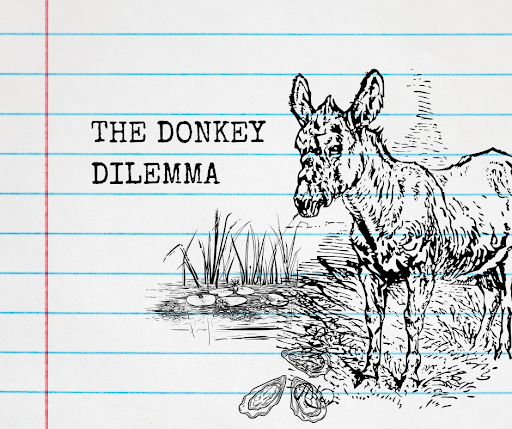
Jean Buridan, a medieval philosopher, introduced a famous example.
A donkey stands exactly between two equal distanced options.
One pile of hay.
One bucket of water.
Both attractive.
Both are reachable.
No reason exists to choose one first.
The donkey waits.
The donkey thinks.
The donkey dies.
Philosophers call this a paradox – I call it a life or death situation choosing between my mom making stuffed grape leaves or getting a gyro sandwich– though his point is simple.
Equal choices slow you down, because thinking becomes the enemy.
You hesitate because both options seem correct.
You keep thinking because you do not want to pick wrong, and then end up stuck.
A World Overflowing With Options
Fast forward several centuries.
Now the donkey has WiFi, a smartphone, and a Zara nearby.
Yet the problem remains.
Take Amancio Ortega, founder of Zara.
He built one of the biggest fashion empires.
He was previously listed among the top ten wealthiest individuals in the world.
His company produces thousands of new designs every year and pushes fresh inventory constantly. This installed the idea of “Fast fashion.”
Back then, stores released a few collections each year.
You waited for summer or winter.
Whatever didn’t sell went on clearance.
Now trends last a month.
Sometimes two weeks.
Shoppers came back because the store always has something new.
Sales become unnecessary.
Products disappear before you even decide if you want them.
People love choices. They love expression. They love individuality.
But when a single store gives you more options than your entire childhood wardrobe, something shifts.
You feel free, yes.
You also feel overwhelmed.
Your brain can only process so much before it shuts down.
When Smart People Refuse to Choose
Mark Zuckerberg, creator of Facebook, once answered a question about his identical gray shirts.
His explanation was straightforward.
He wants to remove small decisions from his day.
He saves mental effort for important work.
He leaves outfits to the gray shirt, and the navy suit for sessions in congress.
Even billionaires get tired of choosing.
This idea appears in psychology as well.
Barry Schwartz wrote about it in The Paradox of Choice, arguing that more choices often create less satisfaction.
More options raise expectations.
Higher expectations raise disappointment.
You think you should have chosen “better,” even when “better” never existed.
You see it everywhere.
New phones every year. New laptops every few months. New trends every week.
You feel pressure to make the perfect choice. That pressure ruins the experience.
When More Options Reduce Results
One study captures this well.
Sheena Iyengar, a professor at Columbia University, designed an observational study by setting up tables with jars of jam.
One of them offered six jars. 30 % of people stopped to look, and 30% ended up purchasing.
By contrast, another table offered twenty-four. 60% of people stopped to look, and only 3% ended up purchasing.
But why?
Because choice tires people. Thinking drains energy. Indecision kills action.
This explains why an information overload might draw us back from actually comprehending anything.
You postpone the choice. The choice grows. Your motivation drops.
That is known by analysis paralysis.
Your brain tries to protect you from a “wrong” choice by delaying it.
It creates mental noise that feels logical but does nothing.
The Hidden Cost of Choosing Wrong
Every choice carries a cost. Economists call it an opportunity cost. It measures what you lose the moment you pick one thing instead of another.
You buy an eight-hundred-dollar phone. You lose everything else that eight hundred dollars could have done. Savings. Interest. Investments. Even a week’s worth of groceries. You don’t feel the cost instantly. You feel it when the newer model releases for instance, or another item you wished to purchase that may now be reduced to the same price and your excitement slowly dismisses.
Voltaire once wrote, “The enemy of the good is the better.” ( Additional source : quote) He meant that chasing the perfect choice destroys satisfaction with the good one you already have. You see this every day. You look for the ideal product and then regret the one you picked, not because it failed but because you believe a better option might have existed.
When Small Things Become Big Problems
Parkinson’s Law of Triviality describes how groups spend more time on small issues than on important ones. The smaller the topic, the more comfortable people feel debating it. The big decisions get postponed.
You see this in clubs, group projects, and even friend plans. People argue about the font of a presentation slide instead of finishing the assignment. They can worry about what snacks to bring instead of preparing for the actual meeting.
One may ask how this ideology, seemingly insignificant, is relevant. Though that’s the point of the law itself. People inflate the irrelevant because it feels easier than confronting what matters. They delay choices because the unimportant feels safe and manageable.
The result is the same. Momentum dies.
Why This Matters Now
You live in a world with more choices than any generation before you.
Food, Fashion, Schools, Majors,Career paths, Online content.
Everything demands a decision. More choices look like freedom.
Sometimes they are. Sometimes they steal your time, your attention, and your peace.
You don’t need fewer opportunities. You need better ways to navigate them.
You can start small. Set limits. Pick from three options instead of thirty.
Decide fast on low-stakes choices.
Save your thinking for decisions that matter.
Protect your energy.
Protect your time.
You can’t remove choices from life.
But you can stop them from controlling you.