

















On Monday, June 8, teachers and administrators from across the South Brunswick School District (SBSD) met to discuss the issue of AI in the classroom. At its head, Superintendent Dr. Bernard Bragen Jr. and Interim Assistant Superintendent for Curriculum and Instruction Dr. Jill Takacs revitalized this committee, which was originally created by Dr. Takacs’ predecessor, Dr. Evelyn Mamman. The committee only met for an hour, which dwindled to 45 minutes once it split out into their grade-level K-5 and 6-12 groups. The 37 members convened to address one of SBHS’s biggest problems: how to integrate the new and ever-changing technology of AI into a school system.
Before the meeting began, all members were sent the current Acceptable Use Policies (AUPs) that students, teachers, and parents are required to sign for the coming school year, as well as drafts of new and in-depth AI-specific guidelines to read over. They were also sent the agenda and a district belief statement regarding AI, which states how the district wants to “embrace artificial intelligence as a powerful educational tool while recognizing that the human connections at the heart of learning remain irreplaceable.”
The meeting consisted of what Dr. Bragen described as “passionate discourse,” which got heated at times. The goal was to come up with a plan for how AI would be integrated into classrooms, curricula, and the workplace. However, due to many different stances and experiences with AI, the conversation leaned more towards first finding common ground on whether AI really is the next step for education. The room was divided by department, with some agreeing to shift back to using exclusively pen and paper to meet students’ real and original thinking where they are, while others argued they wanted to best prepare students for futures in careers with projected heavy AI usage.
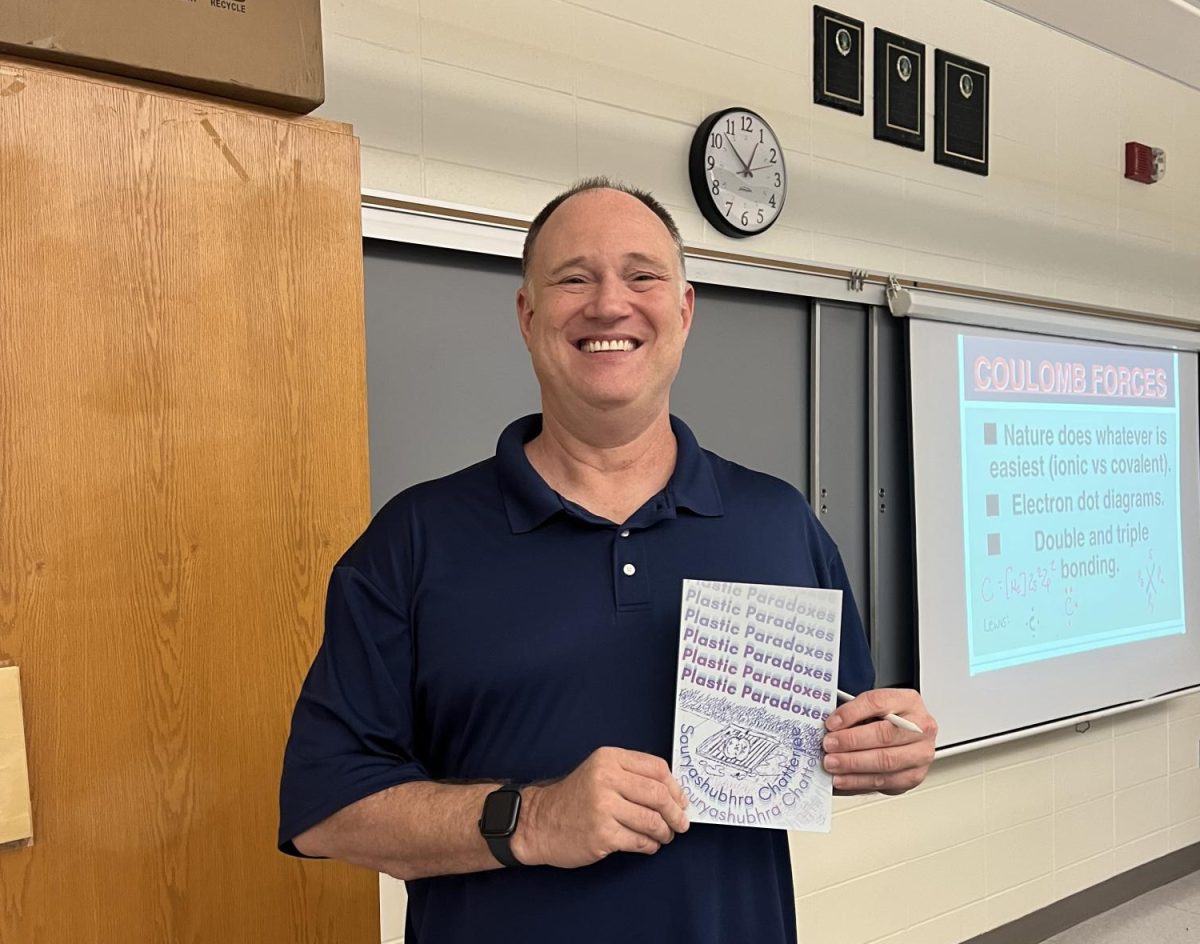
The first thing we noticed, as two of the three student representatives—the third being Adhithi Uppalapati (’26)—was the urgency the administration had in finalizing the policy, combined with little consensus in the room surrounding actual AI and machine learning. Many teachers and students raised concerns about how the integration would work, namely in the English Department, where Mr. James Noebels, an Honors English I and AP Literature teacher, spearheaded the argument against AI having a place in these humanities classrooms.
Another issue that arose was the distinct lack of progress with the policy by the end of the meeting, despite the biggest goal being to leave the meeting with clear-cut next steps and needs. We’re all for taking the time necessary to figure out our needs in the best way possible, but when there’s a deadline looming over our heads, especially when the administration-set deadline is a mere month away (on July 13), we don’t have that luxury. The administration also did not seem very keen on any blanket decisions coming from the top, in spite of Social Studies Chairperson Dr. Justin Negraval’s request for higher-level guidance.
The administration’s desire instead is for decisions to be made from the bottom up, by the teachers, who are the most effective group to make them. In an interview with The Viking Vibe after the meeting, Dr. Bragen shared “School organization systems work much better bottom up. At the meeting, people said that they wanted it top down. ‘Just tell us what to do. I want you to make a decision, because we can’t agree, so just tell us.’ That’s easy. That’s not good, though.”
“For example, we want to change some of this equipment, right?” Dr. Bragen added. “They’re older than you are, some of the devices. So I want to pick something more modern, that’s newer, that will be in the classrooms. But I don’t know what a fourth-grade teacher needs in her classroom to achieve their curriculum goals. I think I could say ‘I think this would be good,’ but I don’t know the nuts and bolts of what she needs every day. But she does. So why wouldn’t we want to ask her?”
Another thing we noticed was the seeming lack of finality with the policy, as there were no edits made to the original draft sent out to the committee. There were also no larger decisions made regarding not only the policy in its most primary form, as a written document, but also in the long-term decisions about how the actual integration would work. Dr. Bragen said, “that’s what I got out of the meeting yesterday. And I think where you left was, we are not there yet. We have more discussion to take place, and people were worried. Well, it’s June, right? We’re working through for the summer, and get this ready for September. So I think it’s a work in progress.”
But again, we don’t have that kind of time to workshop over and over again. When we talked to him about training staff and teachers in AI, whether that’s Large Language Models (LLMs) and Chatbots, or actual machine learning concepts, he recognized this honest lack of time for a constantly developing technology. “We want to always try to make sure we train our staff as best we can and keep them updated on everything. We simply don’t have enough hours in the day to do as much as we want to do. I think the policy won’t be fully implemented. I think it will be something that will be partially implemented, and it will take time.”
All this to say, administration does constantly get issues dumped on them, and their jobs are admittedly difficult when they have to convene, create, and implement guidelines for a school district as massive as South Brunswick. Regardless, Dr. Bragen’s stance seems to raise the question: why attempt to establish all of these new policies and programs if it’s undeniable (and, on the record) that they simply don’t have the time to be doing this properly?
As students ourselves, it’s frustrating to say the least. If the well-being and actual futures of the students were considered, and we mean truly considered, beyond the good intentions of staff, and whatever surface-level activities and programs they implement (like Gaggle and SEL), then why is it so rare for them to be consulted, or at the very least, communicated with?
Mr. Noebels shared his sentiment on students actually learning. “Especially in a place like South Brunswick, where we are a very academic school, if the point is to pursue learning with integrity, then we don’t yet know how allowing artificial intelligence can help.”
The English Department, as we mentioned, was definitely hesitant to accept AI in their classrooms and curriculum, with many teachers sharing the same perspective of how AI was wasting their time in one of the most time-consuming aspects of teaching: grading. They now have to bear the burden of sifting through, quite frankly, fake work.
Mr. Noebels shared, “I’ve been doing this long enough to know how 14 and 15 year olds write organically, and there are now so many ways I can tell right away that something was either done 100% through AI or passed through after and changed after the fact, and it’s frustrating to know that I spend multiple hours a week outside of this building, grading student work, instead of being with my own three children and my own wife. I know that what I’m reading is not real. And that has put me in a bit of a crisis of purpose as of late.”
The Viking Vibe will continue to cover the developments with the AI policy when it goes into effect in the 2026-2027 academic year, and focus on informing and reporting on all perspectives, especially those of students, by conducting interviews that will be published as Q&As. The first of these Q&As will be the interviews we conducted with Mr. Noebels and Dr. Bragen that were quoted in this article, which will be published in full in the fall.