












You can find Part I of this series here
You can find Part II of this series here
You can find Part III of this series here
You can find the conclusion of the series here
Note: Some of those quoted in this article chose to use a self-selected pseudonym to remain anonymous.
To reference Kamala Harris, you did not just fall out of a coconut tree. “You exist in the context of all in which you live and what came before you.”
South Brunswick isn’t unique. It is a microcosm of a culture much broader than any of us. And this culture has instilled in us certain natural biases that are pretty hard to shake, no matter what.
As Senior “Chicken Tender” put it, “A lot of students see STEM as more prestigious or ‘useful,’ especially for college and jobs. Humanities interests are often seen as hobbies, unless someone is really outspoken about them.”
Niles, another Senior, pointed out that, “students reflect the culture around them, and when that culture tells them that English or soft skills aren’t as important as MCLA or AP Chem, they fall into that rhetoric.”
The “hobbies” concept has been echoed a lot. Humanities seemed to have been limited to a “rounding out” agent. People accept that the average person ought to take them, if only to prevent the creation of any mad scientists. We recognize that students going into biology should probably read a bit of Frankenstein, and kids pursuing CS should probably be able to understand the messaging behind Ray Bradbury’sThe Veldt. We understand that it is beneficial to have surgeons with a musician’s dexterity and physicians with a sculptor’s understanding of anatomy. But we don’t actually want our kids to write novels. We don’t want our kids composing masterpieces by candlelight or spending hours in a paint-smeared studio somewhere. We appreciate the culture and the aesthetics of these studies, but we don’t want our kids to devote their lives to them.
Why? Because authors don’t make great money. Neither do musicians nor artists. Or historians or sociologists or anthropologists or the infamous underwater basket-weavers. Dang it, I really didn’t want to come back to this, but it’s true, isn’t it? As much as I avoid it, money really is a major factor in the STEM allure.
“Parents are always concerned about what kind of careers their kids are going into, and so they would rather have them go into careers that pay a lot more money. Which STEM careers do, for sure,” Said Mrs. Samantha Saldanha-Kuncharam, my current AP Comparative Government teacher. When asked why money just has to matter so much, her response came quite simply. “Because things are so expensive! The median age of a first-time home buyer a decade ago was 33. And in 2025, it’s 40.”
Considering recent economic conditions, it makes total sense why your average teenager would be concerned about getting a low-paying job. When I talked to Dr. Aparna Rajagopal, the chair of the science department, she told me the story of a nephew with a highly specialized interest in slavery during the Renaissance (which, unfortunately, sounds awesome to me). He’s been doing pretty well in school, plenty of internships, a trip to Italy, the works. But while talking to prominent professors in this particular field of research, he was told a rather harsh truth. “There are no jobs in this field. You might spend 6, 8 years getting your PhD, and after that, you have to be okay with being a high school teacher.”
Is there anything wrong with being a high school teacher? No. But you could do that with a bachelor’s. The unfortunate thing with a lot of humanities students is that they’ve fallen in love with areas of study that only exist in academia. And while some people absolutely have the wherewithal to dedicate their lives to learning just for the sake of learning, most don’t.
Something I’ve consistently noticed is that humanities students, while also often repeating that they simply disliked the rigidity of most STEM classes, also asserted that the humanities have this almost philosophical importance. It sometimes seems like they feel obligated to defend their passions in a way STEM students simply don’t.
Zaynah, a Freshman, had said, “I prefer humanities courses because I believe human rights are extremely important, and in our country, I have seen how human rights have been neglected, so it is important to spread awareness about human rights and their importance.”
Krish, a Junior, followed a similar sentiment, saying that “humanities courses are important so you can be a better person. I believe that since we live in a constitutional republic, it is essential that we are educated about it in order for it to function better. The citizen you are, in my opinion, relates to the person you are, since we’re part of a civilization.”
Now, I agree with them wholeheartedly. But most students aren’t too concerned about the implications of being part of a society. The average person doesn’t lie awake at night contemplating human rights. Are they bad people for that? No! To be self-aware about things like that is a privilege. At the end of the day, putting food on the table is expensive. And for a group of people soon to be entirely responsible for themselves, being able to pay for their own existence is a big thing. If it means taking the hardest, most impressive, most STEM-y classes on the planet to be able to do that, I think most of us would.
What’s interesting is that it seems that we students are actually the biggest sources of this bias. We instill these fears in ourselves through our own competitiveness.
Sanvi, a Junior, said, “I think my peers influence my final choices because many people like myself crave academic validation, and choosing a class that is lower than your peers can make you feel less.”
And teachers can tell. “I am hearing more and more often that the pressure is coming not from the parents, but from the peers,” Says Dr. Rajagopal. “Students feel very competitive when they look around and see their peers doing better than they are, or when they perceive that they’re not doing as much as their peers.”
Nobody wants to be the dumb one. Especially when lagging behind means risking your chances at a good college admission. Everyone in this school is aware that even your best friends are, at the end of the day, merely more numbers you need to compete against to an admissions officer.
A lot of students also openly admitted to not wanting to join a course if not enough of their friends are taking it. Teachers have noticed this as well. As Mrs. Saldanha said, “I feel sometimes students get discouraged from taking humanities classes because their friends aren’t in them, or, like, they get looks or, like—‘why are you taking that?’”
To be fair, these classes are hard. There are multiple courses I’ve only been able to survive because I had a friend I could exchange study notes and materials with. I could totally understand why the thought of taking a class all alone, especially if it’s one considered “dumber,” would freak some kids out too much.
This fixation with not seeming dumb has seemed to infect every part of modern-day education. None of us wants to take the easy classes. All of us want to, at least, look as though we’re able to survive the tougher ones. But the thing is, the human brain isn’t designed to take in 4 85-minute info dumps, accompanied by an extra hour and a half of extracurricular activities (or longer, depending on the type you’re in), and an additional 4-ish hours of studying for 5 days a week (assuming you’re spending an equal amount of time per class). And that doesn’t even cover things like volunteering responsibilities, internships, and jobs, which many students have. And let’s not forget that students have, you know, lives. Family, friends, chores, social lives, food to eat, sleep to get, hobbies to enjoy. These things are first in line for what most kids are willing to sacrifice to survive.
So we have hundreds of kids all clamoring to get into the hardest classes, mostly attracted to STEM classes due to their prestige, emphatically supported by their tax-paying parents, who just want to ensure their child isn’t doomed to live paycheck-to-paycheck. If the administration wants to satisfy all these demands without burdening our students to the point of complete overload, some sacrifices have to be made in the curricula themselves.
In the education sphere, we’ve seen an increasing amount of fear amongst teachers. We see all over social media horror stories of high school Freshmen taking APs, unable to do basic algebra. English teachers convalesce as they’re given ChatGPTed sentence responses for full essay prompts. All over, we’ve seen the devastated cry of hundreds of educators that critical thinking is dying.
To put it simply, people feel like kids are getting dumber.
Recently, the Social Studies department has either lowered or completely dropped the prerequisites for all of its APs. We’ve seen the same thing happen with multiple other departments. This seems to be how the administration is trying to respond to the demand for access to more difficult classes. In some ways, this is absolutely a good thing. Students should be able to learn about whatever subjects they want, no matter what their current performance in school is. Someone who isn’t exactly shining right now might discover a new passion of theirs if allowed to branch out more. And it’s not like these prerequisites are astronomically low or anything.
But there are also certain downsides to this shift. Prerequisites, as much of a nightmare as they are for most, exist for a reason. They make sure students have the background knowledge necessary to truly grasp the concepts introduced in higher-level classes. If that background knowledge isn’t there, they’re bound to struggle more in class. And this conflict has been felt. “They actually did lower the requirements to get into AP Statistics this year, and to be honest, I’m seeing that here.” Said Ms. Levonaitis. “Where the knowledge that should be there isn’t.”
An AP Stat teacher can’t exactly stop teaching the material in the exam they’re meant to be preparing their students for, just to give them a supplementary lesson on something they should’ve learned last year. We often forget, but teachers also operate on a time limit. This forces them to either have to settle with a class of students that are struggling to keep up, or to ease up their lessons.
“A lot of teachers do echo the sentiment that they had to water down certain parts of their curricula over the years. And that’s in response to the need for that immediate gratification,” said Ms. Weinstein.
It’s definitely an overplayed sentiment, but a lot of teachers have pointed to those dang phones being the driving cause of this behavior shift in some ways. We have shorter attention spans. We want more for less. We want the prestige of AP-weighting and fancy STEM classes, but we aren’t as willing to put in the work necessary for it.
As a student, of course, I feel the need to interject and defend us. It’s easy and comfortable to simply say that you have to earn the prestige that comes with difficult classes. If you want to thrive, you have to be willing to put in the work for it. Equivalent exchange. Every action has an equal and opposite reaction. Lex talionis, an eye for an eye. However, you want to word it.
But even if a kid puts their all into their classes, are they getting enough in return?
According to a CNBC article, over 2 million people earned their bachelor’s degrees in the spring of 2025. Only 30% found a full-time job. At the same time, layoffs are at a high. There were 1.1 million announced job cuts between January and October of 2025 alone. South Brunswick students are seeing this Gen Z job crisis amongst our own friends and family. Meanwhile, it seems like colleges are demanding more and more from their applicants just for a chance of deferral. 10 extracurriculars, multiple awards, leadership positions, a start-up, an untainted 4.0 GPA, and 5s on every AP. We’ve seen some of the most capable applicants get turned down from their dream schools for seemingly no reason.
Most people my age feel this frustrated kind of despair. You can dedicate your entire life to excellence, graduate from an Ivy League, and still end up unemployed. So why should we put in all that work? If excellence is the new minimum, why must I do so much to achieve it? Why can’t I Sparknotes through my AP Englishes and AI-generate through my AP Social Sciences? Were we not taught in school itself that we’re supposed to work smarter, not harder?
Ouch. This paints a bitter picture of what we’re like, huh? And our teachers seem to feel all the anguish, too.
“I feel like there’s not as much dreaming. Like, you’re forced to kind of pick what you want to do way too early on.” Said Mrs. Bufis. “Because you get into high school and you have to pick these classes that align with what you want to do, and you don’t have that ability to explore.”
Mrs. Saldanha has felt the same. “I remember, you know, 15 years ago, so many more kids wanted to be history teachers or teachers in general. And now I just get three responses. Medical school. Business school. Or computer science.”
Mr. John Noble, my Freshman year Physics teacher, said, “Things are a little more fluid…I still think they’re not considering occupations or careers that do not require a college education. Like being an apprentice.”
It really does feel like our generation has lost the ability to dream sometimes. We are so fixated on suffering, or at least looking like we’re suffering. I think human beings have always been like that. We struggle to justify our thoughts, feelings, and desires unless we’re able to manufacture a sob story for ourselves. Nobody plans to get into college with an essay all about the loving family and friendly neighborhood they were raised in. True humanity, or at least how it appears in the movies, is all about survival. We’re phoenixes rising from the ashes. We break down once in a while, but we’re also meant to emerge from our struggles a purer, prettier, warmer thing.
Last year, my mother and I were attending a pooja in our neighborhood. Several aunties I’ve never met before were on the guest list, meaning we were both mentally prepared for some insane investigative journalism. I walked into that lovely suburban home like a criminal into an interrogation room, repeating my Miranda rights like a prayer in the back of my head.
As predicted, one of the first things I was asked was, “What are you going into?”
I was initially going to respond with honesty and integrity, then caught my blunder and quickly lied through my teeth that I planned on becoming a lawyer. Usually, “lawyer” is the one humanities profession I can mention that earns me any approval. I was expecting the standardized half-smile and nod.
Instead, I got a patronizing little smirk and a subtle head shake, followed by an absolutely staggering rant about how being a lawyer is apparently the worst thing ever. Not just for the basic “lawyers are all morally corrupt and evil people” reasons, no, no. She began to dig into the mere concept of putting in all that effort into going to law school and studying as much as possible, when you could pursue medicine instead.
I was baffled. Astonished. This was unprecedented. What, so being a lawyer is off the table now, too? What’s the point in having a society of only doctors? Who’s supposed to defend your kids against all their future potential medical malpractice lawsuits? Would you scoff if your child got elected president, too?
I turned to my mother, utterly baffled, as if to say “Are you seeing this insanity too?” And yet, to my utter dismay, she was nodding along seriously, giving astute little hums and “right”s of agreement. I don’t think I’ve ever felt betrayal like that before. I tried to defend myself, completely forgetting politeness as I sort of stuttered through an ungainly defense of all my dreams, aspirations, and passions. It was a pretty pathetic display of my lawyer potential, but I couldn’t help it.
The moment we got in the car, the argument began. I was inexplicably near tears, my eyes burning, angry at my mom for not defending me. She tried to calm me down, telling me she was just trying to be polite. It didn’t work.
It’s taken me a while, but I think I finally get why that moment upset me so much. It was humiliating. It wasn’t just confusing and strange and laughably rude; it was actively humiliating. I was knocked down so quickly, so swiftly, with so little effort. And the one person I had trusted to be on my side no matter what wasn’t.
I felt that strange humiliation again recently. While sitting between my mom and dad, my laptop settled in front of me, staring at a deferral from one of my reaches. It wasn’t exactly a school I was too personally invested in. I mean, I did like it a lot; it was one of my top schools, and I liked the programs it offered, but I mostly wanted to get in because it seemed a favorite of my dad’s. In my heart, I knew a deferral wasn’t actually a bad thing, and I still had a good shot of getting in.
It was catching the way my dad’s expression shifted while reading through that infernal letter. The excitement, the brief confusion, the realization, and then how quickly he schooled his expression to hide any hint of disappointment so as not to hurt my feelings. Even though I could hear him by my side, telling me not to freak out, that I still have a chance, that my results don’t matter too much in the long run, none of his words mattered as much as that look in his eyes in that one split second. The same look in my mother’s a year ago.
Maybe that’s that mysterious push I’ve been searching for.
A lot of kids like me have grown up constantly hearing about our parents’ pasts. We know what they’ve gone through to give us this life. A part of us knows, deep in our hearts, that no matter how strict or lax our parents are, we are still meant to be their phoenixes. We are meant to be symbolic of how worthy all that suffering was. So we feel obligated to suffer ourselves. And when we get the sense that we aren’t being good enough at suffering, that we aren’t pushing ourselves, it feels utterly degrading. Like an insult to our own existence. Like we failed at the one thing we were born to do.
It’s hard to dream for yourself when you’re meant to be someone else’s dream.
But do our parents actually want that from us? I “forgot” to mention earlier, but I made a survey that I sent out to a few parent groups as well. I didn’t get as many responses. But those I did get were insightful.
Parents don’t want their kids to fixate on one field of study. Jyothi, the parent of one of our current Seniors, said, “Education has to be more diverse with current affairs, what’s going on in the country, world, politics, culture & environment, everything that impacts the society & future.”
Parents don’t want their kids to be taught by doormats, but they don’t want their teachers to be strict either. “I prefer teachers who mentor and inspire students,” said Crisberth, the parent of another Senior. “Teaching with empathy and charisma can create more respect and discipline than strictness.”
While some parents did want their children to be faced with higher academic rigor, most preferred a Goldilocks situation. Right in the middle. When asked what future career they want their kid to pursue, most left it up to the child to decide. Debbie, for example, said she wants her child to have “A career with a future, and one they will enjoy.”
Some very vocal parents might really want their children to be in all the hardest STEM classes humanly possible. Some parents might want their students to really work for their place in society. Some parents are expecting doctorates and mansions. Some. But most parents just want their kids to be happy. If there is anything anyone should be getting out of this article, it’s that your parents don’t want you to suffer on their behalf. They didn’t make you expecting a martyr. They just wanted you.
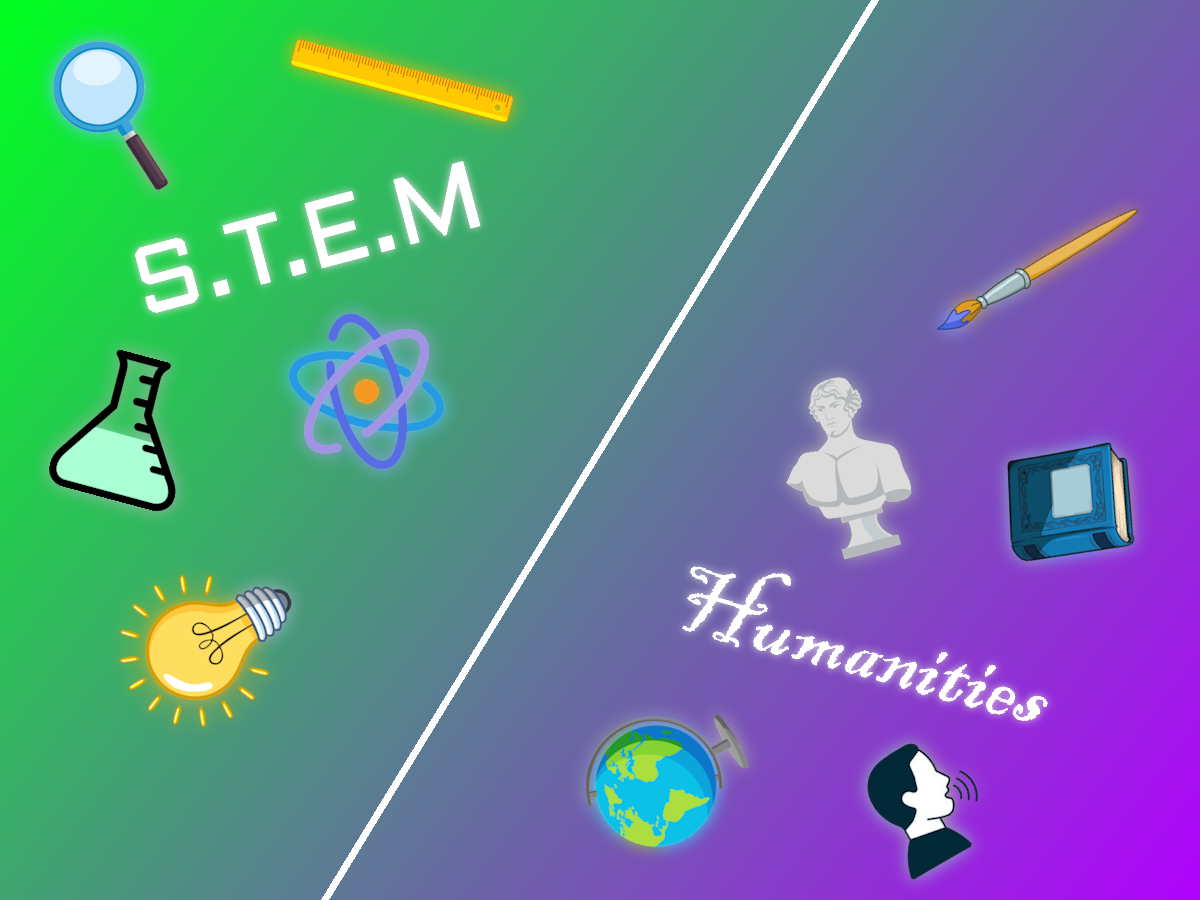
The perspective that the increasing obsession with perfection among our student population is what is driving kids to higher-level STEM classes is half the story anyway. As we established before, most people just like STEM better, simple as that. Our school does provide opportunities for humanities students to thrive, though the general consensus does seem to be that those opportunities should be expanded on a bit more. And in the end, this divide we’ve created between the two umbrellas is entirely artificial. Both the chairs for the Science department and the Social Studies department agreed with that one.
“One thing that school gets wrong all the time is that you can’t force kids to like things or learn things. You can’t. Learning is a natural function of our humanity,” says Dr. Negreval. “It happens whether we like it or not…when it comes to school, not everyone is ready to hear the same message at the same time, in the same way, in the same style, and in the same grade level. So what might be disinterest now is not disinterest later.”
“We’re teaching the very same skills; it’s just that the vehicle that they’re using to teach the skills is different,” said Dr. Rajagopal.
Dr. Rajagopal also argues that students are dreaming. “I actually think your generation dreams bigger than we did…all these ideas that are coming up now, are young people coming up with these ideas…I don’t think dreams are getting smaller or fewer. And your generation is very courageous in many ways.”