














You can find Part I of this series here
You can find Part III of this series here
You can find Part IV of this series here
You can find the conclusion of the series here
Note: Some of those quoted in this article chose to use a self-selected pseudonym to remain anonymous.
I had quite a few methods of research for this article. One of the first things I did was create and circulate a student survey that, in the end, garnered a total of 104 responses. I also wanted to gather the perspectives of teachers on this topic, so I scheduled interviews with as many teachers as I could.
A part of me is convinced that the core of this has to rest somewhere in the relationships students have with their teachers. With the small, personal vendettas we form over disappointing report cards or boring lessons. But a feeling isn’t proof, and I needed proof.
Now…here’s the problem with that. I don’t know all that many STEM teachers, so I was only able to get proper, recorded interviews with 3. The remaining 6 are all humanities teachers. So, admittedly, my data is a bit skewed. In my defense, I think I’ve made it plenty clear that I’m not exactly great with scientific precision.
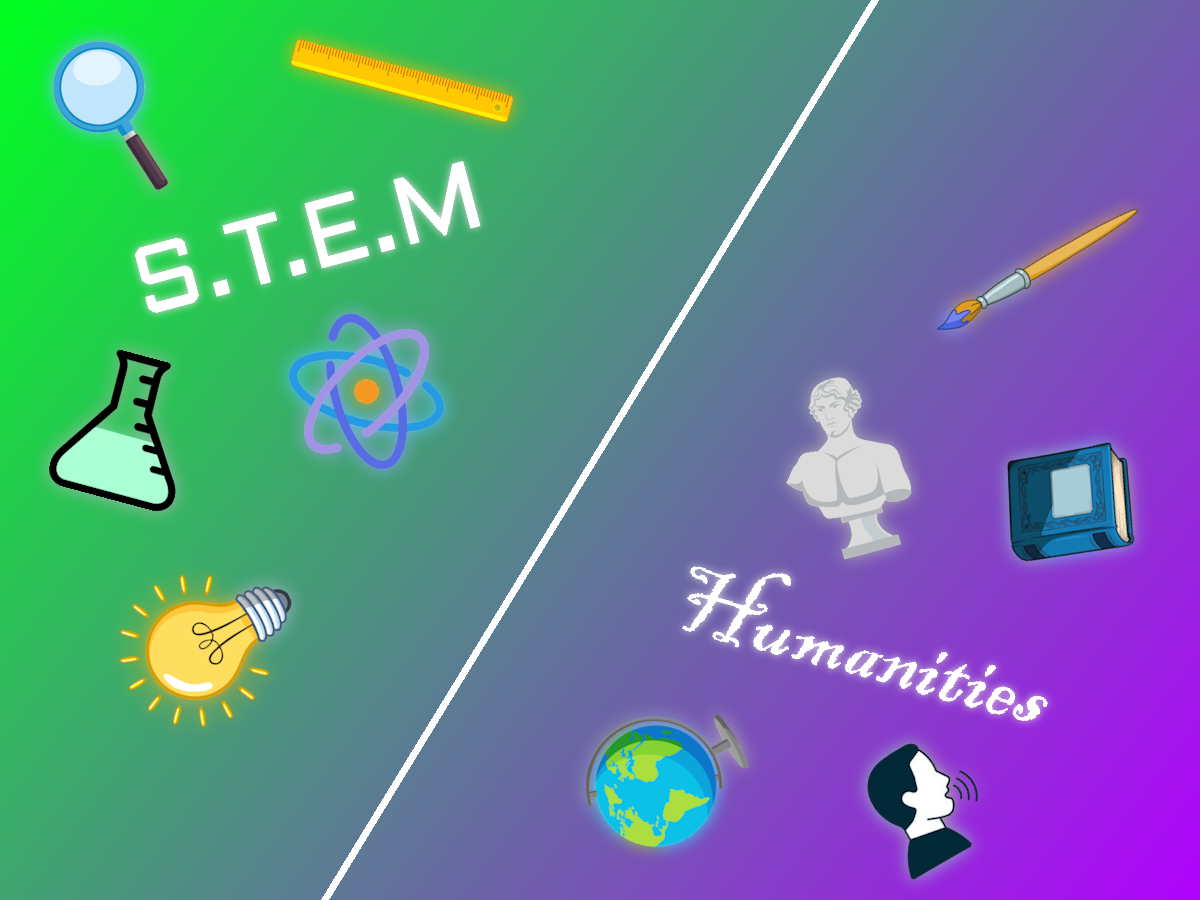
The student survey, luckily, was able to set off this bias a good bit. More than half of my respondents preferred STEM to their humanities courses.
With most of my classes being a form of English or a social science, I’m used to an echo chamber. Most of the time, when I get a chance to talk to other humanities kids about this topic, we tend to dismiss our school’s STEM majority as only pursuing the field because their parents told them to and they don’t want to be broke. In the actual survey, however, very few kids actually mentioned their parents or monetary incentives at all. The plurality of students simply stated that they found STEM classes more entertaining, interesting, and fun.
Beyond that, some students seemed to have an inherent problem with the structure of the humanities. Shivam, a Junior, said that, “With humanities, I feel a lot of grades are subjective to the teacher, as opposed to a STEM course. With science, there is a definite right and wrong.”
People have always split themselves up into the archetypal right-brained, emotional, subjective type and the left-brained, logical, definitive type. It would make sense if that were the sole factor here. But subjectivity alone isn’t what seems to hurt the reputations of these classes in our schools. It has to do more with how that subjectivity affects the quality of teaching itself.
“It’s not that I hate humanities courses, they are interesting to learn about…However, at the end of the day, I don’t have strong public speaking and writing skills,” says current Senior Ally. “I also don’t really like how the humanities are taught and graded. Some teachers teach it really well, while others make the class as if they want us to hate it. Unfortunately, I got more of the latter teachers than the former.”
The quality of a teacher seems to be one of, if not the biggest, factor for most kids when picking out their courses.
Aanya, a Freshman, said that “I used to really like math when I was young, but I didn’t have a good Algebra teacher in seventh grade, which made me lose my interest in math. I’ve always liked literature and reading, and since I already had good teachers for those, I’m still into reading and writing.”
Students largely use peer feedback to determine how good a teacher is. And it seems that humanities teachers may have historically drawn the short end of the stick when it comes to how students view the efficiency of their teaching methods.
The difficult thing with the humanities is that they are personal in nature. Literature is all about how you interpret and feel about a piece of writing. Social science is all about how you understand and feel about the world around you. But the inherent structure of school forces teachers to standardize these things across the board. It’s hard to teach and grade the abstract, so teachers are obligated to remove a lot of the natural nuance that comes with their subject matters for the sake of simplicity. How do you make assignments that allow kids to truly use the humanities as explorations of their humanity?
Teachers also have positions of authority over students, which allow them to dictate what is right and wrong within the borders of their classrooms. Do I want to say there are teachers in this school purposely trying to force their own beliefs onto their students? Not necessarily. But it’s hard to avoid bias from seeping into lesson plans, isn’t it? English teachers can’t have Socratic seminars every block. If they want to make sure their students understand the texts they’re reading, they have to pick out one specific “correct answer” for as many key elements as they can. And it’s only human nature to gravitate to what you already think and believe. That means a student’s personal interpretation of a symbol or a unique motif that only they identified may get ignored in the process. Not to mention that teachers tend to act as gatekeepers. There’s a lot of protection of the “classics” against any criticism, and that leaves other forms of literature to be neglected, including those that better reflect the values and sensibilities of current students.
Essentially, the only assignments that teachers can give their classes to measure their personal opinions are essays and group discussions. Of course, essays are notoriously time-consuming for both the person writing them and the grader. When you have multiple other classes that you’ve been told to care a lot more for, it’s hard for you to rationalize putting in all that effort into something so draining.
And, as mentioned by multiple surveyed students, including Ally, some people just aren’t good at speaking in front of groups. And there’s nothing wrong with that.
I’ve found that a lot of teachers constantly insist that public speaking skills are necessary, going out of their way to prompt students to participate. I don’t think the average student is going to deny that knowing how to talk to people is an important skill, but to be blunt, the average person isn’t going to find themselves regularly engaging in formal debate with groups of up to 30 people. These teachers have good intent, but it seems as a whole that kind of pressure serves to hurt their cause more than it helps it. Being constantly pushed into speaking as much as possible, especially when a person’s grades are at stake in the form of participation points, can make a classroom feel scary.
I have personal experience with this. I’m a pretty open and talkative person in class now, but as a Freshman with crazy bad anxiety, the thought of speaking too much in class freaked me out. I’d force myself to with as much bravado as I could muster, to the point of annoying my classmates, but I have entire units of courses erased from my memory because I blacked out the moment I opened my mouth as a self-defense mechanism.
But, to be fair, there is a valid reason why teachers value participation in class so much. Mostly because students…aren’t participating.
While interviewing teachers, one of the most common refrains among those teaching humanities courses was that they constantly felt like nobody actually…cared. At all.
When talking about this with Mr. Andre Halaw, my AP Literature teacher, he said, “I don’t believe [students] devote the time they need to, perhaps, to work on an assignment. Because I’m constantly policing students who are doing their STEM work in my class. So, to me, that’s an indicator that class not only takes more priority, but it requires more time because it’s spilling over to mine.”
I’ve definitely seen that in my classes. It’s become sort of an open secret, a joke with a never-ending punchline. Both teachers and students are perpetually aware that half of the kids with their laptops open aren’t doing their work or “taking notes.” They’re finishing up their Calc AB work or playing Geometry Dash.
Part of it, as Halaw said, is a testament to how we use our time at this school. We have a lot of highly demanding classes. At some point, you run out of time in the day to devote to all of them. So you make sacrifices. A class that assigns less work and is easier to cheat through via ChatGPT is lower on the list of priorities compared to others. You can type that prompt in later, but you’re already running late on the assignment open in front of you.
What I want to know is why the humanities seem to be such a low priority in the first place. And based on the data I’ve collected, a lot of it has to do with the culture at our school.