



















This past school year, Mr. Friedman and Mr. Honig’s AP Language and Composition classes wrote a full year process essay on any topic of their choice. We called this The Eagle Essay, after the final paragraphs of Annie Dillard’s classic essay “Living Like Weasels.” After the submission, students read and evaluated their classmates’ essays and selected the top two per section. The Viking Vibe is proud to publish these top essays throughout the summer. Check back in every Monday to see these outstanding essays, selected from over 140 total works. Enjoy!
——————————————————————————————————————————————————————
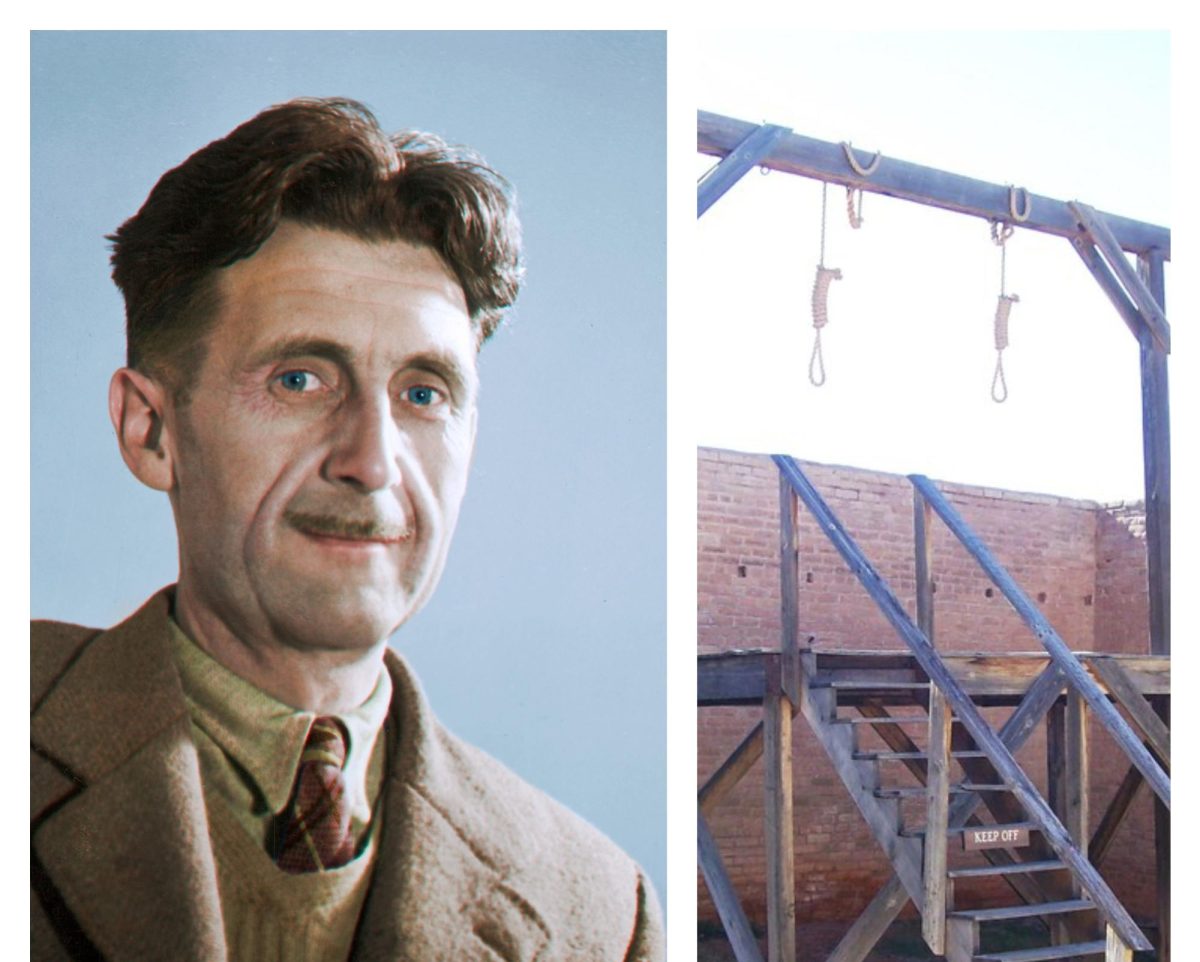
I: “A Hanging” Pt. 1
There is a crowd at the hanging.
A perturbed swarm of individuals pushing and shoving one another about, foaming at the mouth to be in the room in which it takes place. A herd of roused and violent predators, agitators, who circle the stand.
On the gallows, is a man being put to death.
He with a narrow nose and blistered palm, looks out into the courtyard as if trying to distinguish the people among the trees. He is a slender man, held upright by branches of withered skin molded to the curve and length of his bones. His rather veiny neck is adorned only by a noose.
The man sways gently, rocking from side to side, thrown off balance by the sudden breeze. His fingers tremble lightly but he does not so much as exhale loud. His mouth seems sown shut. All he truly cares about is finding a person among the trees. From his peripheral vision, he can make out a brutish figure moving towards the lever, and he responds only by feeling the slight tremor rack through the floorboards beneath him, and wincing his eyes shut for a mere moment.
The crowd falters slightly. Where is the thrashing?—Where is the screaming? God forbit—where is the amusement? Behind me, a little boy groans and tells his father that they must have just “missed it”.
In the few moments after, the lever cranks with a Screeeeeech. And gravity overwhelms the man. There is a silent jerk and an unheard crack, albeit the rhythmic drop of his saliva onto the concrete beneath is deafening. His body worms about, and he makes these gasping nasal sounds that rest only after a few minutes.
The crowd had dispersed already by then, muttering beneath their breaths. One man kicked down the trash can by the side of the exit, another woman cursed rabidly. The little boy turned back to his father and proclaimed they “might as well’ve missed it”.
It had been mere minutes since the hanging. Nevertheless the sky turned red, the man’s lips turned blue, and the storm passed.
II: “A Hanging” Pt. 2
The first George Orwell essay I read was “A Hanging.” It described a Hindu man being put to death in Burma, present day Myanmar. It was a gruesome tale of death before the killing–of power and lack thereof–at least on surface level that is what it described. I haven’t slept quite as well since then, some nights I’d wake up shivering, having dreamt of it happening before me. Every time I’d watch the man put to death, I’d watch the crowd of inmates blur, I’d wake up panting; and do it over again. Perhaps more worrisome for me, was that I couldn’t understand why. Why did I feel bile rising in my throat?—Why did I care so much about the narrative?
I racked my brain, until my palms were stained and my head would no longer think. I stared into my wall for weeks begging it to rip open. Other times I’d twist my necklace until it coiled up into a knot and tightened at my neck.
I wanted to smell the soot, and taste the salt in the air. I wanted to hear the clack of Red coats echoing across the prison corridors.
I wanted to thrash, I wanted to scream, I wanted to fight.
Fight in place of a man who didn’t. A hunger gnawed in me, giving birth to a raw sense of desperation. Desperation that can only come from hope and hopelessness converging into reality. A desperation that rooted so deep my chest that wove into my hands and onto the pages and pages I wrote. By the time my ink had smudged and the pages were soiled, I was confident I’d changed something.
And when I was finally happy with my own writing, I re-read “A Hanging” so that the words would finally escape the page and speak to me. But it never quite works like that does it?
By the end of it, I was sure of only one thing.
I’d never read “A Hanging” to begin with.
III: “A Hanging” Pt. 3
I took a break from Orwell after “A Hanging”.
They say distance brings clarity, that it sharpens the mind and offers perspective. So they say.
When I returned to the essay, it seemed I had little clarity, and even less perspective. I was caught in a tireless back and forth with a deceased author and his paperweight essay.
I didn’t know if there was any gold at the end of this rainbow, not that it was much of a rainbow, more so a dull cloud of complex essaywork and a migraine on the side. Nonetheless I was convinced if Orwell was telling me something beyond the words on the page, then I would uncover it.
Therefore, I decided to read more of Orwell’s work. I analyzed “A Day in the Life of a Tramp,” 1984, “Shooting an Elephant,” and “Politics and the English Language” before returning back to “A Hanging”.
I deliberated and then arrived at my conclusion.
Which I will not share at the moment, because I wish to digress.
IV: Ignorance Is Not Bliss
What is the most rational thing in the world?
To be self-interested.
Self-interest, despite the taboo, is less a crime than it is instinct. As humans we evaluate what is important to us, that is our way of dealing with the limits of life. So why is it wrong to choose what we do and don’t ignore? Why is it wrong to ignore what doesn’t affect us?
The saying “ignorance is bliss” is a dialetheia.
Willful ignorance is in nature, a tangential act. Should you be a bystander to another individual being assaulted, you would’ve had to first encounter the assault, and despite that interaction have chosen to move away from it, following the same path as before.
The reasons for which “ignorance is bliss” are fairly straightforward. There are always implicit costs to interfering. The negative externalities, or consequences of action, are the drivers behind ignorant behavior. When an individual chooses to bystand, they ultimately spare themselves the risk of getting involved, the effort of jeopardizing their safety, and the trouble of disrupting their peace. To some degree, their ignorance makes sense.
So why do we say it’s wrong to be ignorant?
Because ignorance is egoistic.
18th century philosopher Immanuel Kant created the “Categorical Imperative” (CI) philosophy. To understand it first we must understand the distinction between ethics and morals: simply put ethics are societal values whereas morals are personal values, they are interconnected but not the same. At its core, CI is a “universal moral law that is accessible and applicable to all rational beings” (Biscontini). It states “first, that individuals should act according to maxims they would wish to become universal laws; and second, that people should treat others as ends in themselves and never merely as means to an end” (Biscontini).
Why are both of these principles rational? Because they are both egoistic acts. In a nutshell, I should act according to the way that I think society should act and if I wish to be treated well, I must treat others well. Or conversely, I should act the way society acts, and I should treat others well so I may be treated well.
Essentially the paradox is that to be rational one must be both egoistic and altruistic (Kraut).
We perceive wilful ignorance as wrong because it defies CI and results in an entirely egoistic world, which is not in our best interest.
Ultimately cognizance is never not a risk, but it is a risk we must take.
V: The Capacity To Care
There are 60 seconds in a minute, 60 minutes in an hour, 24 hours in a day, 7 days in a week, and 52 weeks in a year. The average person lives 71 years (Dattani et al.). Which means, an average person has around 2,232,921,600 seconds in their lifetime. How will they allocate their time?
By prioritizing what they care about.
When talking about willful ignorance, I’ve learnt it’s important to put it into perspective. While we can simply say that ignorance is wrong because we value altruism, it’s important to put it into perspective. Our civilization is plagued with a number of issues, and it becomes difficult to give attention to each and every cause. How much attention do we expect individuals to give?
And at what point does lack of attention simply become ignorance?
I believe that distinction happens when the individual loses their “capacity to care”. In order for any one individual to care enough to actionize, at least one of the following conditions must be met:
- The scale of the situation must be relatively small
The scale of the situation is how closely the situation impacts an individual and what they value. Ignorance on a smaller scale is much harder to practice. When the situation pertains to your workplace, community or family unit there is an additional imperative for you to act.
- The situation is relatively elastic
The elasticity of a situation is how much impact an individual’s actions have on the situation.
If the situation is elastic, then it becomes easier to act because your actions will have some direct influence on the issue at hand. The greater the elasticity, the greater the inclination.
I believe inaction and ignorance are the consequence of indifference. If a situation pertains to many, its scale is large, and it is relatively inelastic, most people will be indifferent to it. In other words, indifference is the result of detachment. For something to matter to someone, it either has to influence them on a personal level or be within their sphere of influence.
That is the individuals’ capacity to care.
VI: The Trick Around
How do you get someone to care about something, if neither condition has been met?
Working around the capacity to care can be done multiple ways through pressure, or power. But personally, I believe nothing works better than an appeal to emotion.
The capacity to care is entirely dependent on the idea that humans are rational beings. But that’s not quite reality, in fact there is one confounding variable that skews the dataset entirely: emotion, which creates the irrational being.
You can force someone to take action if you evoke their empathy, fear, anger, etc., to the degree necessary for them to care.
The distinction between a good and a great writer is how well a writer’s words can influence their readers. Granted most writers can evoke some type of emotions from their audience, but great writers can chokehold the emotions, meaning they can manipulate their reader’s emotions intentionally. If the exceptional author wishes you to feel sad, you will not simply feel “sadness”, instead you may feel the agony and anguish accompanied by words on a still page or some other wallowing grief.
Emotion, contrary to popular belief, is difficult to manipulate. Just like no canvas comes with a particular skill set needed to use it, anyone can write but that does not mean they can emote. To be adept at conveying emotion through exposition or narrative, is a skill only the best writers can hone.
In reading so much of Orwell, his ability to emote was perhaps one thing I observed as a motif throughout his work. For my readers, “A Hanging” is the perfect example of Orwell tugging my empathy and turning it into an inferno of such catastrophic curiosity that I now sit here writing about it. Even now, part of me feels a lingering sense of despondency and listlessness
“A hanging” in my opinion is arguably one of Orwell’s most expressive works because it had this nuance to it, that was so particular and grainy it’s almost hard to describe. Nonetheless, everything from his tone, to the essay’s matter of fact nature, captured a message that was intended to take the reader seconds away from storming London itself.
Orwell did something inexplicably amazing.
Orwell got me to care.
VII: Ending Remarks
Alas we have arrived.
Perhaps, you are exasperated or cynical at this point, wondering whether or not I’ve just led you on some random goose chase. Undoubtedly, many of the things I’ve written are intuitive in nature, but in writing they are an overlooked experience.
Writers write for many different reasons.
Some write to resolve themselves of some intrinsic burden, others write to express a personal anecdote. But almost always there is a message that the writer is trying to convey. That is, hence, the purpose of rhetoric.
And what most often gets the reader to care about that message, is their capacity to care or their feelings.
So at its core all good writing aims to make you care about it.
I have not accomplished that goal, I have not explicitly given you much of a reason to care, nor will I. This essay is a personal reflection, and it has little to do with you.
The message Orwell delivered through “A Hanging” was of death before death. He wrote “It is curious, but till that moment I had never realized what it means to destroy a healthy, conscious man.” (Orwell, “A Hanging”).
My visceral reaction to “A hanging” was because I was agonized by the essay. Despite not having the capacity to care, I did care. I cared because Orwell made me, and in the end I was forced to confront the very reality that there was nothing left to change or affect me. It was regret, for an inevitable outcome.
There was a certain helplessness that overcame me the day I realized this. It felt much like sludge climbing up cold skin and softly peeling at it.
Nothing can be changed for the man, not now, not ever. But something can be changed for the future. When you feel, you care. And if you truly care, then arises a fear of complacency and a desire to act so urgent and instinctive that it begins to consume you.
To change something you must care, and that is as simple as it gets.
Works Cited
Biscontini, Tyler. “Categorical Imperative | EBSCO.” EBSCO Information Services, Inc. | Www.ebsco.com, 2024, www.ebsco.com/research-starters/history/categorical-imperative.
Dattani, Saloni, et al. “Life Expectancy.” Our World in Data, 2023, ourworldindata.org/life-expectancy.
Kraut, Richard. “Altruism.” Plato.stanford.edu, 25 Aug. 2016, plato.stanford.edu/archives/fall2020/entries/altruism/.
Orwell, George. 1984. Secker & Warburg, 8 June 1949.
1984 was one of the two books I read in advance of writing my Eagle Essay. I refer back to its plot, characters, and themes to expand on my analysis of the book as a whole. Since my essay looks at my perspective on Orwell’s big takes, 1984 is from where I’m drawing some of my quotes to build upon my central idea of Inaction.
—. “A Hanging.” The Orwell Foundation, 20 Oct. 1931, www.orwellfoundation.com/the-orwell-foundation/orwell/essays-and-other-works/a-hanging/.
I used “A Hanging” by George Orwell, in my essay multiple times. it is the central motif to the essay because it was the first Orwell essay I read. I start my Eagle essay off with my own rendition of “A Hanging”. And I discuss my personal experience with the essay and difficulties analyzing it in the primary paragraphs- it sets up the thesis statement claim. .
“Profiles in Courage Excerpts | JFK Library.” Www.jfklibrary.org, www.jfklibrary.org/learn/education/profile-in-courage-essay-contest/teacher-information-and-curriculum-ideas/curriculum-appendix-2.
Certain excerpts from JFK’s Profiles in Courage, that I read earlier, have relation to Orwell’s essay “To Shoot and Elephant”. I had expanded on this connection in my writer’s notebook with a full page synthesis. While there is not any analysis that connects Profiles in Courage to the essay at the moment, I have been re-reading and evaluating the source, because it serves as additional material to discuss directly from a political figure..