














This past school year, Mr. Friedman and Mr. Honig’s AP Language and Composition classes wrote a full year process essay on any topic of their choice. We called this The Eagle Essay, after the final paragraphs of Annie Dillard’s classic essay “Living Like Weasels.” After the submission, students read and evaluated their classmates’ essays and selected the top two per section. The Viking Vibe is proud to publish these top essays throughout the summer. Check back in every Monday to see these outstanding essays, selected from over 140 total works. Enjoy!
—————————————————————————————————————————————————————
When I think back on my childhood, I don’t usually remember it in terms of summers or school years; I remember it in Minecraft worlds.
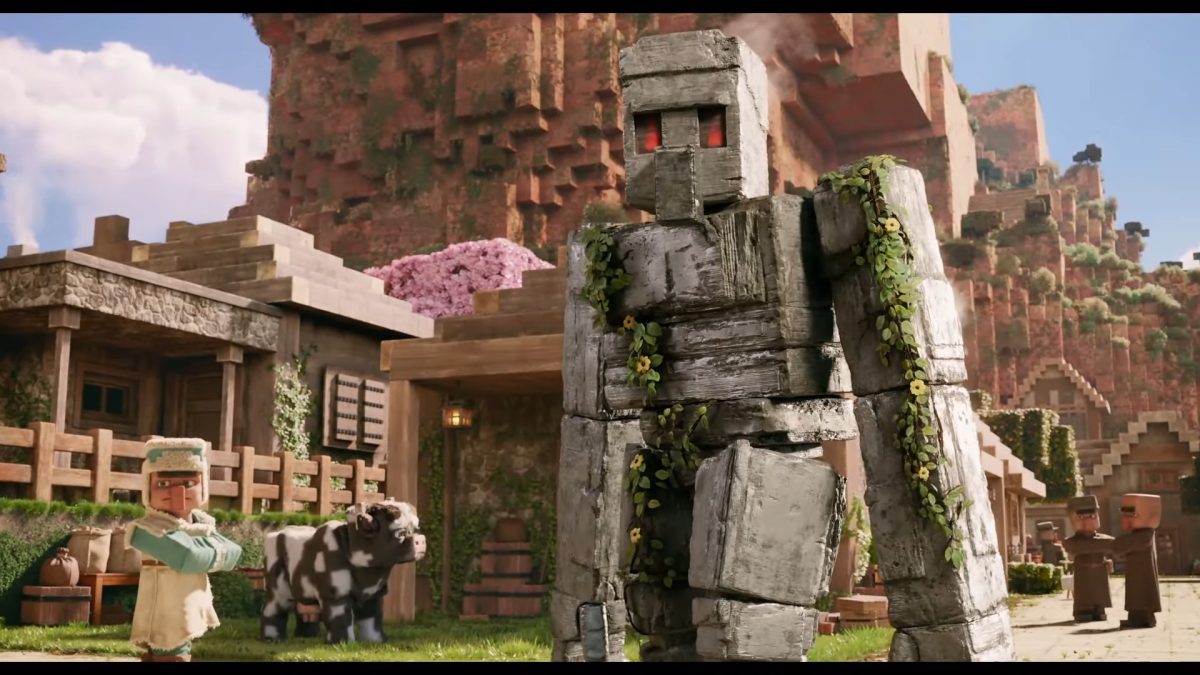
For anyone who hasn’t played it, Minecraft drops you into a randomly generated world made entirely of blocks, dirt, stone, wood, water, all of it stacked in cubes. There are no instructions. The first time you load in, the game gives you nothing. You figure out that you can punch a tree to get wood, craft wood into planks, planks, into sticks, sticks into tools. At night, hostile monsters, called “mobs”, spawn, zombies, skeletons, spiders, creepers. They will try to kill you and when you die, you lose all the items you were carrying. The world itself is theoretically infinite, generating new terrain in every direction as you walk. You can survive, build, farm, mine, fight. You can do all of it, or none of it. In this game, there is complete freedom.
That freedom, though, didn’t feel liberating at first. It felt terrifying. The clearest world I remember is my first one. A random forest, a square sun that dropped too quickly for my liking, and me frantically punching trees as the sky got dark. By midnight in that world, at the first sighting of a zombie or skeleton I’d dug out a hole big enough to hide my character in, listening to the groans and bone-clattering overhead. As a kid I was already scared of monsters, and even though these ones were made of cubes, my heart still pounded and my palms dampened the keyboard. It didn’t feel like a sandbox game where I could express creativity, it felt more like a horror game where survival was the only goal. Those first nights weren’t fun, exactly. But they taught me what it felt like to be completely out of my depth and have no option but to keep digging.
What eventually changed wasn’t that the game got easier, but that I stopped waiting for it to. After enough nights in that dirt hole, I started to notice patterns: the sounds faded around dawn, the skeletons burned in daylight, the zombies wandered predictably. So I began preparing instead of hiding. I’d sprint to gather wood before the sun finished setting, punch together a small house, and spend the night listening from the inside rather than underground. Then, once that felt manageable, I pushed further. I built up enough courage to actually leave the spawn area and head somewhere with no plan except to see what was out there. Once I had goals–find a big cave, mine a lot of ores, build a nice base–the mobs stopped being things to hide away from and became small hindrances in the way of bigger projects. The cave music still scared me, though. That low, resonant hum the game plays when you’re in the deep dark underground. It always felt like it was warning me of something.
That sense of danger became even sharper when I started losing things. I’ve thought a lot about death in Minecraft. You spend hours working through dark caves, the ambient soundtrack doing its best to unsettle you, carefully picking through stone for iron, redstone, lapis, and the occasional flash of diamond, and then a creeper silently steps out of a shadow and detonates. Or lava flows out of a block you just mined. Or you dig straight down, fall into a cave system filled with endless amounts of mobs. All of it, gone. The first few times I lost a full inventory of gear I quit the game entirely and did something else for a while. Eventually I started doing things differently, things like, carrying a water bucket for lava, always having enough food and wood when you go mining, and stopped digging straight down no matter how impatient I was. None of it came from a guide. It came from losing everything enough times to care more about not losing it again than speed.
Those losses didn’t just frustrate me, they taught me. Each death left a specific residue, a habit, a hesitation, a route I stopped taking. The water bucket is a good example of how this works. Lava in Minecraft pools and flows and just touching it can kill you before you have time to react. The first time it happened to me, I lost maybe forty-five minutes of mining. The second time, I lost a diamond pickaxe I’d been working toward for hours. After that, I never went underground without water. I didn’t make a rule about it. I just didn’t forget what it felt like to watch my entire inventory disappear.
That permanence is what makes dying in Minecraft different. In most games, death resets you to a checkpoint. In Minecraft, death drops your items where you died and resets your position to your spawn point, which might be thousands of blocks away. If you can get back to your death coordinates before the items despawn (five minutes), you can recover almost everything. If you can’t, it’s gone. I once sprinted for four minutes straight across a desert biome, compass-less, trying to find the cave entrance where a skeleton had shot me off a ledge. I didn’t make it in time. I stood at the surface, staring down at the ravine where my gear used to be, and felt something that was more than annoyance and frustration. It was a kind of sick knowledge that no matter how much I wanted to rewind, I couldn’t, and the only option left was to start over with empty hands.
That same feeling of being boxed in without control showed up again during COVID, but in a completely different way. When everything shut down, Minecraft and its endless terrain gave me freedom I didn’t have in real life. It became the only place where I could still “see” my friends. We couldn’t meet up after school or hang out on weekends, but we could join a call and log on together like nothing had changed. The same blocky terrain that had given me heart attacks time and time again turned into a meeting place. On our multiplayer server, we would set huge goals for ourselves, building massive bases in survival, or jumping into matches on the Hive server to fight other players. My laptop lagged constantly, freezing, or just kicking me out the game all together, but I didn’t care. The frustration of a dropped frame or having to reboot the game was nothing compared to the feeling of being able to exist somewhere with my friends again, even if that place wasn’t physical. Minecraft gave structure to my days when everything was uncertain. It was proof that even when the real world felt empty and isolated, I could still build something meaningful with other people, even if it was made of pixels.
At the same time, the difference between playing alone and playing on our survival multiplayer world (SMP) changed how I understood the game. In a solo world, it was just me against everything. If I died in a cave a thousand blocks from spawn and lost all of my gear, there was no one to blame and no one to help me recover it. Getting lost meant wandering in circles, hoping I would recognize a hill or a river. It was frustrating, but it forced me to be independent and careful. On our SMP, though, survival felt like running a small society. Each of us had a role: one person gathered wood, another farmed food, someone mined for armor and tools, and someone built a base to keep us safe. What I did actually mattered because it affected everyone else. If someone didn’t play their part, we all suffered. Through a game, I learned both how to stand on my own and how to contribute to something bigger than myself.
This dynamic came out most clearly in our biggest projects. The mega builds were where all of that collaboration got loudest and most chaotic. We’d agree on something, a castle, a massive farmhouse, an underground base connected by tunnels, and then everyone would start simultaneously without a real plan and somehow it would come together. Someone would be screaming that we were out of stone, while someone else quietly added decorative stairs to a wing we hadn’t finished yet and someone else, and this happened multiple times across multiple builds, “accidentally” set the whole thing on fire. It was relentless and sometimes things got heated, arguments about who used the wrong materials or built something in the wrong spot. But even with the arguments we had, no one quit. We finished things because we cared about the ridiculous pixelated structures. We cared in a way that was hard to justify out loud, but it didn’t need justification among the five of us.
At one point, we built a fully enclosed prison cell for one of our friends because he kept stealing from our personal items and destroying things for no reason. The cell was obsidian, the hardest block to break in the game, requiring a diamond pickaxe and about ten seconds per block even then. We trapped him inside, walled it off completely, and told him he could come out when he agreed to stop. He did not stop. We found this much funnier than if he did. The cell became part joke, part monument. It was a reminder that even in a game where anything could be broken, we still tried to hold each other accountable.
The Skywars sessions were the complete other side of the coin. In survival, we were serious or at least trying to be. Skyward was pure chaos from the moment we queued in. The mode drops you on a small floating island surrounded by other players on their own islands. There are chests on your starting island and on the center island which contain random gear: swords, bows, armor, food, potions. The goal is to build bridges over to other islands, loot what you can, kill other players, or knock them off the edge. The goal, in theory.
In practice, the five of us spent the first several games exclusively griefing each other, breaking the blocks out from underneath our own teammates so they would fall and die before the opposing team could get to us. It was obviously a terrible strategy but we thought it was the funniest thing any of us had ever done. Eventually after we got tired of this, we started actually competing, developing strategies mid-match over voice call, deliberating about which island to push first and who was going to act as bait.
My friend recorded a couple moments out of the hours of matches we played, so every failed trap and every improbable win ended up on his YouTube channel, including the rounds where we completely dismantled each other. Watching those clips back, you can see the shift. The early matches are just screaming, falling, and everyone dying within the first five minutes. The later ones have a different quality, still loud, still chaotic, but with a more coordinated feel to it. There’s one clip where we pull off a perfect bait. One of us lures another team across a bridge pretending to be weak and alone, while the rest of us wait with snowballs, knocking the entire enemy team into the void when they rush over at him. In the background you can hear all of us losing our minds on the call, relieved that we finally managed to pull off what we’d been planning.
I rewatched some of those videos, looking for something specific I half-remembered, and ended up going through more of them than I meant to. Our voices are higher than I remembered, and we are so loud, screaming over things that from the outside look like nothing, a trap going off a second too late or someone leaving their teammate for dead in the middle of a fight. But what struck me more than any of that was how present we were. There’s a version of the COVID years in my memory that is mostly grey and formless, one long undifferentiated stretch of waiting for things to go back to normal. These videos are evidence that something else was also happening simultaneously. We were building things and burning them down and rebuilding them. We were making rules and breaking them and enforcing consequences with obsidian block prisons. That we were there with each other even when we couldn’t actually be anywhere.
There’s a specific texture to the memories of those years that the footage helped me recover. The particular sound of a creeper hiss, which is a high-pitched fizzle indicating it is about to explode. The visual of a freshly lit Nether portal, a purple shimmering rectangle that looks alien against whatever landscape you built it on. The low thud of hunger depleting when you’ve been running too long. They’re simple things, but they carry the weight of that time.
And within it all, there were the people who shaped how I played. The rest of my friends weren’t horrible at the game, but my friend Alex was especially good. He was the one who knew how to build complicated farms, who could speed-bridge across a gap without falling, who somehow always had extra food and plenty of diamonds in his chest when one of us inevitably lost everything. When we pushed into the harder parts of the game, large caves, the Nether, the End, it was usually Alex who led the way, placing torches, blocking off lava, and acting like there was nothing to be afraid of. Watching him made me feel braver. It’s easier to walk into the dark when you’ve seen someone else do it and come back with diamonds.
I still play sometimes, though not often. When I load into a new world now, I notice the sun dropping and I know exactly how much time I have before it gets dark, and I don’t feel the panic I used to. I gather wood automatically, craft tools without thinking about the recipe, and throw a furnace and a bed together before night falls. The fear that once sent me scrambling underground has gone silent and was replaced with the confidence of knowing what to do next, a steady sense of direction that had nothing to do with coordinates and everything to do with experience.
In that sense, Minecraft has become more than a game I used to play; it’s something like a language I grew up speaking. Its worlds mark the stages of my life the way school photos do for others: the first terrified nights hiding in a dirt hole, the quiet single-player grinds, the sprawling SMP bases glowing under a cubed sunset, the frantic SkyWars bridges and the echo of our laughter in a year when the real world felt empty. When I think about growing up, I don’t just see birthdays and grade levels. I see portals and prisons and pixelated castles, all the places where I learned, in a world made of blocks, how to lose, how to rebuild, and how to keep walking forward, even when the sun is going down.