














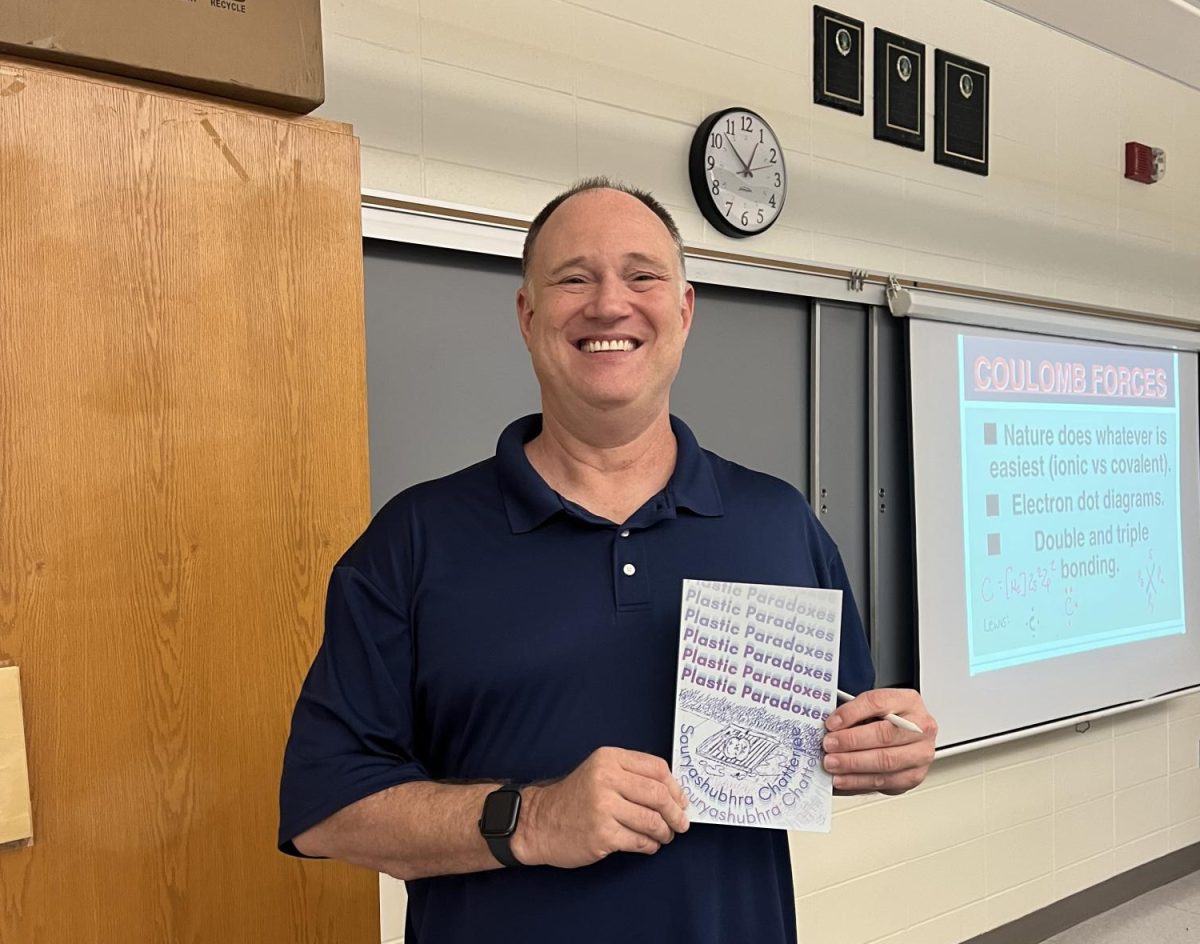
All AP Chemistry students at South Brunswick High School will be familiar with the phrase “All AP Students Eventually Receive the Grades that They Can Afford.” Organic Chemistry students will be twice as familiar with it; this essay serves as the course introduction for both classes (except with the “AP” parts removed). In retrospect, it’s a little weird that for two of the most intensive hard-science classes at the school, the first few words you read during the summer assignment are about the Great Depression; that the first assignment is a letter responding to an essay; that the piece references teachers who have long since retired from the school themselves.
Mr. Burnett’s presence, and the unique character and charm he’s brought to this building, is ubiquitous. A “canon event” some would say. A friend of mine required surgery this year, and even at Robert Wood Johnson Hospital, he and the main physician could bond over being taught by Mr. Burnett—both probably having responded to the same essay and tolerated the same corny jokes and listened attentively to the same story about Dr. Cakir being bald. Ubiquitous, like I said. Ubiquitous.
Impressions are one thing, though; portraits are another. And as ubiquitous as “the Burnett Experience” may be (I always got the feeling he wanted a Netflix special), it never really seemed like a definite picture of the full character of one of the most expressive, multidimensional figures in the school. My friend’s physician—could they mention that Mr. Burnett is an adamant writer of literary poetry? That he was admitted to Cornell and Columbia…for Creative Writing? Now that Mr. Burnett is joining Dr. Cakir in being bald (and retired)? The pieces, disparate as they are, can be put together, and the life of one of the school’s most notable educators studied.
Mr. Burnett, who has long been a supporter of our efforts here at the Viking Vibe, agreed to answer some questions about himself.
—————————————————————————————————————-
How long have you worked at SBHS? Before that? What has changed at SBHS in the time you’ve been here? How has education changed?
I’ve been at SBHS for twenty-five years, and before that I taught at Jackson Memorial High School and Middletown North High School. When I arrived here, the school felt smaller, quieter, and more traditional. Over the years, I’ve watched SBHS grow and continue to embrace diversity, creativity, and student voice and input in a way that resonates with me and makes me proud.
Education as a whole has shifted from a model of compliance to a model of connection. Students today ask deeper questions, challenge assumptions, and expect authenticity from their teachers. And honestly, that’s made me a better educator. The classroom is no longer a place where information is delivered—it’s a place where meaning is made together.
You always tell stories in class. Do you want to highlight any for the Viking Vibe?
My stories come from a simple truth: students learn best when they see the human being in front of them. I grew up in a complicated home, worked my way through college, and spent years teaching in places that shaped me. I tell stories because I want students to know that life is not linear—it’s a series of pivots, recoveries, and unexpected openings.
If I had to highlight one story, it would be this: When I was fourteen, a teacher told me I had a voice worth developing. I didn’t believe her at the time. It took me almost forty years to return to writing, but that one sentence stayed with me. I tell that story because you never know which moment will become the hinge of someone’s life.
Do you have any messages for current SBHS students?
Yes. Three things:
First: You are allowed to change. Who you are at sixteen is not who you will be at twenty-six, or forty-six. Give yourself permission to evolve.
Second: Don’t confuse perfection with excellence. Excellence is effort, curiosity, and integrity. Perfection is fear wearing a mask.
Third: Find something that makes you feel alive—a subject, a craft, a sport, an art—and follow it with seriousness. Not because it will give you a career, but because it will give you a self.
What are your post-retirement plans?
I’m entering a new chapter with a mix of gratitude and excitement. I plan to continue writing, revising my manuscripts, and submitting work to journals. I’ll also be spending more time at the beach, and beginning a new teaching position that allows me to work with students in a different capacity.
And, honestly, I’m looking forward to rediscovering who I am outside the rhythm of bells and hallways. Teaching has been my life for nearly four decades—retirement isn’t an ending, it’s a recalibration.
Opinions on arts and culture? Any music recommendations?
Arts and culture are not luxuries—they’re the architecture of meaning. They teach us how to feel, how to imagine, and how to understand each other.
As for music: I always tell students to listen widely. Classical, jazz, rock, folk, hip-hop, country, R&B, metal—each genre teaches a different emotional vocabulary. Music is a form of emotional literacy, and the more languages you speak, the richer your inner life becomes.
What do you like writing and why?
I write poetry because it allows me to distill experience into image, color, and emotional architecture. My work blends realism and surrealism, memory and landscape, because that’s how I understand the world—through the textures of place, the weight of memory, and the quiet moments that shape us.
Writing is how I make sense of what I’ve lived. It’s how I reclaim the years I lost to silence. It’s how I stay honest.
How does it feel being published? Any advice for students who want to be published?
Being published feels both humbling and affirming. It’s not about validation—it’s about connection. When someone reads your work and sees themselves in it, that’s the real reward.
My advice to students:
- Write bravely. Don’t imitate. Don’t apologize.
- Revise ruthlessly. Good writing becomes great writing in revision.
- Read widely. You can’t write well if you don’t read well.
- Submit without fear. Rejection is part of the process—it’s not a verdict on your worth. And most importantly: write because you love it, not because you want to be published.
Anything else you want to add?
Yes. Teaching at SBHS has been one of the great privileges of my life. I’ve taught thousands of students, and each one has shaped me in ways they may never realize. If I’ve given anything to this community, it’s because this community has given so much to me.
I’m leaving with gratitude, with pride, and with the hope that my students continue to build lives filled with curiosity, compassion, and courage.
———————————————————————————————————–
I (Sourya) think, if there’s any further commentary I can provide on this interview, it’s that we often confuse ubiquity for “one-ness.” As if everyone will get the same experience with an educator.
That’s not necessarily true. Mr. Burnett himself mentions “change,” and alludes to how he has changed over the years. It’s very likely that as ubiquitous as the Burnett experience was, every single student every single one of those twenty-five years got something different out of it. We can and should bond over having been taught by Mr. Burnett, but ultimately, those classic stories, and the little bits that changed every year, had a different impact on every student he reached. Every student who read his Great Depression essay wrote a different response letter, and Mr. Burnett read every one.
I think that philosophy comes through most when Mr. Burnett encourages all students to seek an identity through arts and culture. That is a science teacher telling you to do that. A science teacher who has himself left the boundaries of what is expected from him to give you a remarkable experience. Ironically, maybe even paradoxically, it may be that encouragement, that full embrace of individuality that makes the Burnett experience so ubiquitous.
In this final section, I gave former Burnett students an opportunity to comment on what was memorable about their very own “Burnett experience.”
Bruce (‘26): Burnett’s stories are always interesting and he’s chill.
Blossom (‘26): I would say both Mr. Burnett’s attentiveness and his humor really made class fun while we learned difficult content. He always tutored us for free outside school hours so I admire that dedication.
Abir (‘26): Mr. Burnett always helped everyone engage in class. We always used to do a “question of the day,” which always encouraged a more accepting learning environment.
Christian (‘26): I think one of my favorite Burnett memories was back in freshman year when he would sing C is for cookie, it’s good enough for me, from Sesame Street. That sense of humor and lightheartedness grew into an environment where I could freely express myself and grow authentically.
Chloe (‘27): Mr. Burnett’s stories were always so funny. But besides that he was just really good at teaching and like guiding us through the material and you could tell that he was very passionate about what he taught.
Advait: (‘26): The best part about Mr. Burnett and his class was that he showed that he was deeply knowledgeable about the subject he was teaching and he truly cared about each student in the class. He made sure everything was covered for the AP exam and he cared about how all his students did. He made sure that everyone was prepared for college and they had all the information and background information they needed for a successful future no matter what field they went into. And that was shown through the applications of chemistry which he taught us in class and the DOT and applications we had to present about for each lab. And also he taught with humor which made his class all that more enjoyable.
Clay (‘26): Mr. Burnett is a really funny teacher and I really find the songs he plays as we do our labs to be funny too, especially the Billie Eilish songs and that clean up song he plays too when it’s near the end of the block. His class is always so much fun!
Saketh (‘26): I originally disliked Chemistry, but Mr. Burnett made it amazing. It was my pleasure and an honor to have had him three times throughout high school.
Siddhartha V. (‘26): Chill guy. He’s a good teacher and a funny person.
Abdulmalek (‘26): He is the funniest chemistry teacher. Hands down.