











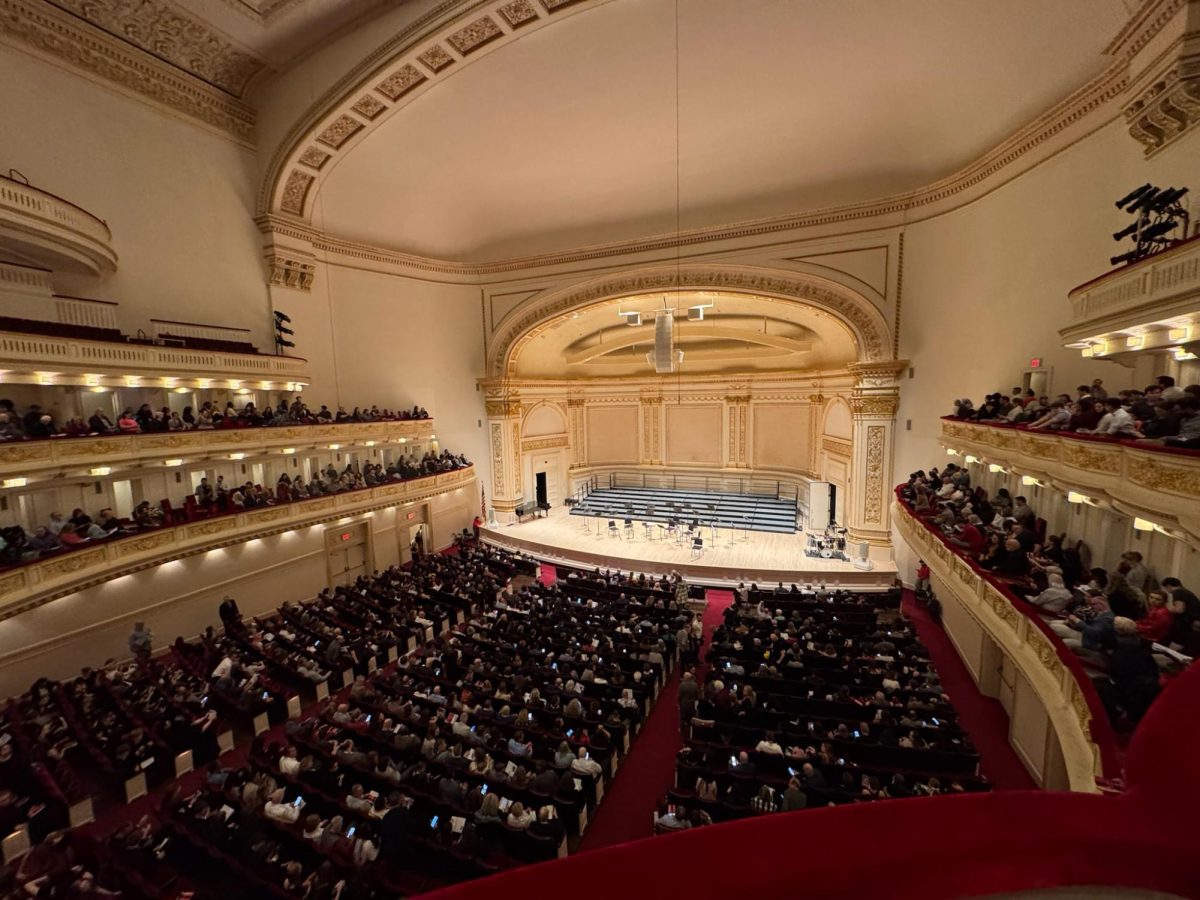
On Monday, March 9th, SBHS’s Concert Choir had the opportunity to perform at Carnegie Hall in New York as a part of the Octavio Series Choir. Presented by the Manhattan Production Concert series and conducted by Dr. John Wilson, the choir sang with three other choruses after spending the weekend rehearsing their powerful repertoire together.
For the Saturday and Sunday before the concert, members of Concert Choir were summoned to the high school two hours ahead of time to attend rehearsals in the Westin Time Square Gershwin Ballroom located right in Times Square, NY. At 6 PM on March 7, and 9 AM on March 8, the choirs rehearsed for about three hours at Dr. Wilson’s direction, with an additional rehearsal at 10 AM the day of the concert. Soprano Concert Choir member Seher Kaur (‘26) said, “I was excited overall, that kind of bumbling excitement under your skin. I was worried that being in a hotel banquet space wasn’t going to be a good sound. But the first note we dropped sounded so rich and cool. I now knew how our songs were supposed to sound, and it came from just the first 20 minutes of that first rehearsal.”
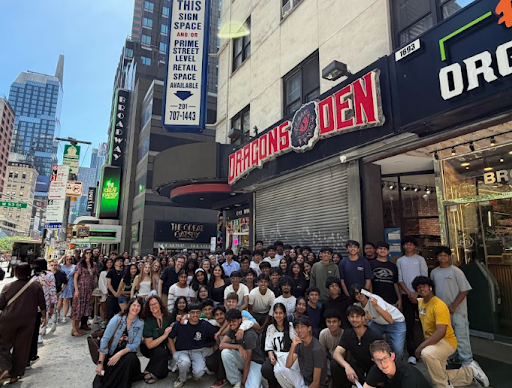
Since the Monday rehearsal ended at 12:30 PM, and the choirs were not needed until a soundcheck at 5:30 PM in the Stern Auditorium inside Carnegie Hall, Concert Choir members were also given the privilege to explore 42, 43, and 44th streets in between 7th and 8th avenue (the blocks directly around the Westin Hotel) in groups until it was time to get ready for the concert itself.
Since its opening in 1891, Carnegie Hall has been a stage of musical excellence in a wide variety of genres. The venue includes the Stern Auditorium, Weill Recital Hall, and Zankel Hall hosting 500-plus performances per year. Featuring musicians from Tchaikovsky (known for his Symphonies and music in Balanchine’s The Nutcracker) and classical music, to The Beatles in pop (and now SBHS’s Concert Choir!), these acoustic halls have had many famous performances that make it a unique and prestigious opportunity for any choral or other musical group.
Besides the Concert Choir, led by choir director Mr. Aldo Aranzulla, the Hillsborough High School Chorale directed by Ms. Ashley Mathews was also invited to perform. The other two ensembles participating, the Riverside Choral Society based in New York, NY and the SUNY New Paltz Festival Choir from New Paltz, NY, were conducted by Dr. Wilson. All four of these choirs were interspersed in the traditional SATB (Soprano, Alto, Tenor, and Bass/Baritone voice parts) arrangement.
Right before their soundcheck, Mr. A gathered just the Concert Choir members together for the last time, all dressed in their formal black attire. “I hope you all take a mental picture standing on that stage,” said Mr A, “and capture this moment, these feelings, of getting to perform on one of the biggest stages in the world that not everyone will ever get to.”
The combined choir’s first piece, “Tuba,” is not about the brass instrument, but a traditional South African protest song that translates to “Dove.” Arranged by Michael Barrett, the song originated from a time of institutionalized racism in South Africa under an all-white government from 1948 to 1994, called the Apartheid (based on the social project name by the oppressive National Party). To emphasize the message of peaceful protest, moves such as extended points and strong fists during step-touches were added to the performance. Five baritones were chosen from the combined choir for a solo, including Concert Choir Baritone Satvik Dhananjay (‘26). Ululations – or the passionate vocal howling or wailing – were also dispersed throughout the song by selected soloists, like Kaur.
The next piece in the repertoire was Mozart’s Requiem featuring “Dies Irae” (Day of Wrath) and “Lacrimosa” (meaning weeping or full of tears). When learning the former, Mr. A taught his choir the importance of energy and power throughout, and how stressing the text amplified their accuracy of the tone of the piece. Correct vowel shapes were also extremely important with such a classical and known piece. Famously, Mozart only actually completed the first eight measures of Lacrimosa’s score, with the rest being filled in by his student Franz Xaver Süssmayr. While there are many other versions, this is the most popular and the rendition the Octavo Series Choir performed.
“O Love” by Elaine Hagenberg was one of the most emotional songs in the repertoire. Written in 2016, Hagenberg took Scottish Minister George Matheson’s poem from 1882 and set it to music. The work depicts the “joy that seeks [him] through the pain,” and the memory of heartache the writer experienced after his own wedding was called off when he became blind at 19 years old. Through the beautiful, tender melody, and faith in a tearless tomorrow, the choir reportedly made many parents of Concert Choir members shed a tear in the audience.
In a burst of jubilation, the choir then sang “Great Day” arranged by Stacey V. Gibbs. A traditional upbeat marching piece, the choir expertly changed keys acapella (or without instrument accompaniment) twice throughout the song. In rehearsal, the combined choir learned a new technique of snapping at the cutoffs, as Dr. Wilson told them how the voice follows the body, and any hand movements or breaths that you do. “Choir is the one place where everyone breathes at the same time” said Kaur, echoing the words of Mr. A. Not only is this important logistically for the phrasing of a melody or harmony to be correct, but creates something Kaur describes as “intimate and special.”
To end their portion of the concert, the Octavo Choir performed “Total Praise,” by Richard Smallwood in 1996 and arranged by Patrick Barrett and Doreen Rao. In addition to the choir, the first verse was sung by soloist [name] before being repeated two times by the choir, and ending with a show-stopping build-up of “amens” in this contemporary gospel hymn. Altoist Zara Marzo (‘27) said, “My favorite piece was Total Praise, even before we went to Carnegie, because of the drums with it and the soloist Vinroy was so talented. Something about the song kind of gets to you inside, like you could feel it.”
After a brief intermission (giving time for the choir to take their seats) the combined choir was able to watch the rest of the concert, as the Festival Octavo Series Chorus filed onto the risers. This ensemble featured choirs all the way from California, Michigan, and Colorado as well as New Jersey.
Kaur, like many other members of Concert Choir, agreed that their best piece was saved for last. “I like to say ‘O Love’ is my favorite piece, but singing ‘Total Praise’ in the hall sounded like heaven. There’s no other way to describe it, it was legit like golden rays of sunshine on my face and nothing else can compare to that feeling.”