













I. The Greatest Gift of the World Language Show
There has been, in the recent century or so, a general movement towards minimalism in the arts. A tendency to leave the audience with a level of power in interpretation. To make the story underspoken in a way The Grapes of Wrath or The Brothers Karamazov, or—in the theme of productions—the operas of Mozart do not attempt. Flowery prose is no longer as common when we value realism and the arts as a reflection of the real world rather than as an amplification of it.
I do love realism. I do love realistic characters and plots. I do love the story as an avenue to tell truths and do love the idea of using language meaningfully—of every word being perfect and essential—but I feel that if everything is the same in nature, we lose originality, we lose spirit. We lose some of the color to it all, some of the risks we would have taken had we valued fullness over optimization. And really, it’s all an echo of our times in other ways. Our times when corporate conglomerates and large language models overpower the agency of the individual economically and socially, and the Dow demands efficiency in the same way the big five publishing houses do.
Thus, when we find something small, charming, and—oftentimes—rebelliously maximalist, full of itself, we savor it. That’s why, by some definition, South Brunswick High School’s World Language Club Talent Show is the greatest show on Earth. In some ways, the piece is messy—certainly; but the spectacle of it all: the scale, is brilliant. The show with around twenty-six separate acts in six different regions, ten different languages, comic interludes between them all; the show which for apparently no reason includes a playlike plotline with hundreds of lines and jokes and genre-busting elements to complement the talent—that is the show that delights you through its fullness; that is the show which sells hundreds of tickets, and has the audience chanting, and grows to one of our school’s largest productions. That is this show to which few others can compare—one which, I’d argue, deserves to be taken as seriously as its best moments demand.
II. Regarding The Program Itself
The chattering audience filtered into the auditorium on March 6 between 5:50 and 6:10. The initial mood was one of eager expectancy—added to by the usage of physical tickets, which were clipped traditionally by Dr. Debari and members of the World Language Club board. Treasurer Emiliano Reyna Padilla (2026) and President Isel Abdelrahman (2026), both smartly dressed and beaming, handed out multicolored program pamphlets by the auditorium door. As patrons took their seats and the lights dimmed, Co-President Zayne Mogadati (2026) came out with World Languages Supervisor Mr. Thomas Decker to give opening remarks. This year’s audience was the largest the show had ever received, and definitely the most diverse in terms of content and regions covered.
The first image viewers saw was that of a montage of various countrysides around the world, which—on such a large screen—created a feeling of magnificence akin to what one would sense watching Lawrence of Arabia. Following one last fast-paced introduction video and interviews by the club’s senior board members came the plot—another new feature of the 2025 show. Senior Megha Kumar (2026) narrated the adventures of Christian Polilen (2026) and Tanisha Kinikar (2026) who with the use of a teleportation device decided to see as many cultures as they could in just one day—à la Jules Verne. They first visited Latin America and Iberia.
The performances began in a fulfillingly operatic style—fiery, grand, theatrical, emotional—through the romantic duets of Renato Granados Mendez (2027) and Britany Aimara Sosoranga (2026), who goes by Azul. Their Spanish-language performances lasted three acts—the first being a vocal from Renato, the second a couples dance, and the third a more somber piece from Azul. It was wonderful to see the show begin with such vibrancy. This movement very deliberately led into a deeply personal, restrained section of the show—with one more vocal/dance duet, this time by Arielle Tu (2026) and Veda Yuktha Gaddamanugu (2026), and a wistful ranchero song in Portuguese by Shiva Tushar Akkireddy (2026). All performers wore traditional cultural costumes, which also added to the deep, pining, sincere feel of this section of the performances. This tension was then satisfyingly shattered through the hip, upbeat dance numbers of three different Spanish classes (Ms. Dowd’s, Alonso’s, and Abrego’s).
After a short transition scene from the Eastward-bound Christian and Tanisha, the show teleported to France—where Isel and later Marjan Malihi (2026) sang two more yearning French songs. Then to Italy, where Dr. Debari spoke of his heritage and the brilliant diversity of South Brunswick High School. He was then joined by Emiliano, Ishaan Wadhwani (2026), and Mrs. Debari on the guitar for a grandiose southern Italian song dedicated to his roots, for which he proudly waved the Italian national banner and adorned the classic blue Italian football jersey. This showing compelled the viewer into a very specific place and time, which is an aspect the show excelled at throughout.
The next performance was a guest comedy routine by—as he was named on the advertising material for the performance—“Manny so Uncanny,” a very dad-joke version of Mr. Caravano.
Christian and Tanisha then reached the Middle East, which began with a traditional Farsi vocal, again by Marjan, and one in Arabic by Angela Hanna (2029). Isel, Lily Hassan (2029), Celina Iskaros (2029), and Amy Melendez (2029) then did one more upbeat dance to an Arabic song, before Carlos Khalifa (2029) and Arsh Vahora (2028) joined for a traditional men’s dance. Azul returned once more for a stunning belly-dance performance; and Azerbaijani Farida Samandli (2027) and Farzana Alam (2028) appeared in costume to perform a traditional dance as an uncredited performer streamed the national flag of Azerbaijan between the two. This section was a wonderful return to what made this show perfectly magnificent.
Next was the India section of the performance, where the audience were met with a romantic guitar and vocal performance by Yug Vyas (2027)—who the crowd seemed to adore—and a Bollywoodesque dance by Aanya Hariharan (2028). The maximalism in this section was perfect, but the mood was dampened slightly by some of the jokes written for plot, including the “butter chicken” joke, where Tanisha’s character taunted Christian by labeling him unable to handle spice (of butter chicken?) with a campy, heavily accented pronunciation of the food.
Then, before the East Asia section, came the final special guest to the show. Gene “the Viking Machine” Hutmaker assumed his second hip persona, that of “the Rapper, sometimes Dapper.” The beloved SBHS icon rapped in his usual articulation to widespread audience appeal, being sure to mention his upbringing and service in Vietnam. Before the China section however, there was one more uncomfortable plot joke, where Christian’s character—as soon as he arrived in China—felt the compulsive need to bow—which is not even done in China and serves only as lowbrow stereotypical humor. The production should be above this.
There was a small and deeply sincere interruption from narrator Megha, who had been working tirelessly—and apparently now had been instructed to stall the performance as the next section was being readied. Nonchalantly, she described how she loved the Spanish section as she would be going to Spain soon, and corroborated Christian’s inability to take spice—which she said she related to. I really enjoyed this interlude because Megha’s sincerity was a wonderful contrast to the more “hit or miss” lines written for Christian and Tanisha.
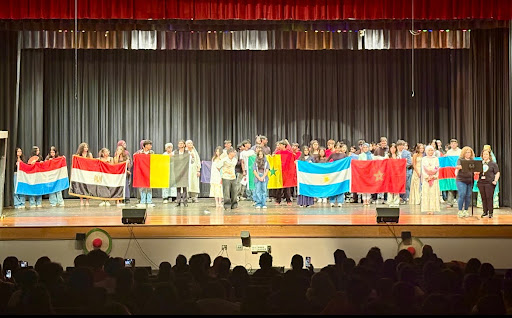
The East Asia segment began in China, with a modern vocal from Sarah Laktaif (2028) before another modern piano-performance and soft singing segment by Sebastian Huang (2026). As we were nearing the end of the show, Balaram Srikant (2027), Riyansh Bandigari (2027), and Niwin Somu (2027) harmonized for a Japanese vocal from the One Piece anime—all while carrying printed Japanese flags. This section landed significantly better than many would have expected it to, because it seemed the three really were taking to their roles despite how silly the act would obviously be. It was delightful and made me smile. Finally, Lucas Gatcia Lopez (2028) demonstrated his expertise in Korean Taekwondo, before all the performers came on with flags to tastefully end the show and enshrine the value of diversity in South Brunswick’s history.
There is a trend you should be noticing with this review: that the show—as maximalist as it is—works best when it embraces that maximalism wholeheartedly. A show about diversity and culture lands when it embraces the real sincerity of it all. When—on the other hand—the show holds back, acts ironic, winks at the audience saying “I know this is stupid, just go with it,” the beautiful themes of the production are diminished. The comedy section disturbed what was until then a building crescendo of the beauty in culture, and treated the audience to an ironic stand-up routine that felt only like an interruption to the worldliness.
This could have been done right, as in Megha’s similarly homey, but more sincere admission that the rest of the show was on the way; or even through the One Piece group’s steadfast singing, despite the silly material; or even beloved Gene doing what he clearly loves doing, rapping—but it wasn’t. It just wasn’t. Every time the show stopped taking itself seriously, shifted its beaming smile to a smirk, it suffered.
That’s the same reason the stereotype jokes felt so awkward—because we know the show is above that. We know it can do great things, we’ve seen it do great things, we’ve heard the opera, felt the Lawrenceesque grandeur! And now we’re treated to easy material that knows it’s easy, that’s so unfulfilling that even the actors cannot deliver it sincerely. This is a serious show. This is beautiful, and it—all of it—should see itself that way.
III. Behind the Scenes
Shashank wanted me to give thanks to the audio team in this piece, so I shall do that. It is absolutely not easy to manage the sound for such a large show, and the team was always able to recover past the various unwanted hiccoughs—including various instances of microphones being nearly silent. The show must go on!—of course. And for the most part, it did.
I also met with the World Language Club team a day before their performance to ask a few questions about the production. This wasn’t a formal interview, though I did take notes.
Aranyo Dutta (2026)—officially the Secretary of the club—introduced himself as the “Director and Stage Manager and Video Manager, also Script Author and also Casting Director” of the show. All performers auditioned under him, and in the actual performance he could sometimes be seen running across the stage with massive earphones and all-black garb. I was lucky enough to catch him making some final edits to the script, including renaming what was previously the “Arabia” section to “Middle East” to make room for Azerbaijani and Persian performances and removing a joke about a shooting star (which was actually changed such that it would not get interpreted as a reference to the ongoing conflict in Iran). The way the script was written and approved by administration, every edit required a new iteration of the document. By the time the show was officially put on, they were past version thirty.
“We utilized AI to make images and videos and some soundtracks to improve our show,” said Aranyo. This was later specified to only include the transition elements between acts and not any major part of the show. Isel—who has for two years directed the performance, including jointly with Aranyo this year—interjected by saying that AI was only used to give context to the general theme of the show.
Isel and Aranyo then brought in a large tray of the multicolored pamphlets and said that they had split the work on them. I received the first official copy as Aranyo explained that the stamps design on the left inside page was actually completely artificial intelligence. Though AI certainly is a controversial subject, I cannot say that in this case the show would have been better without it. Some of the animations would have been logistically impossible for the club to create otherwise.
Like a classical comedy troupe, Christian and the others bickered over the appropriate pronunciation of “gyro,” which some of the performers would apparently be receiving as a gift on performance night. Christian—who is participating in lent—specified how he wanted one with no meat.
I also talked to Zayne, who the other members of the board said had been handling the paperwork. When I found him, he was running errands down the busy halls of the school. He explained how making so many edits under the administration is difficult, and also thanked Aranyo for his other work for the show.
Aranyo remarked, post production, that: “Backstage management is certainly a difficult job, a logistical nightmare; I think there are opportunities to learn going forward. I’ll admit that I made mistakes, whether cueing an act at the wrong time or giving the wrong person the mic. But it’s also just hard to manage kids.” He then showed me his general system for the process, a self-made website with numerous simultaneous tabs dedicated mostly to time management. He added, “we actually finished earlier than we were expecting.”
Marjan, who managed much of the audio, called Aranyo a “passionate director,” and explained that much of the board had been having to stay at the club every day for an hour to finish final preparations—which for her had been many, many file conversions. “Ghobrial sent us to all our teachers to promote the show, and they all got really annoyed with us,” she added—visibly stressed. It’s the commitment. A small, overworked, argumentative group of people putting on something far larger than themselves—and somehow, when the lights go down and the auditorium fills, it works. That is the truest, most beautiful form of maximalism—proud dedication—and the greatest gift of the World Language Club show.