

















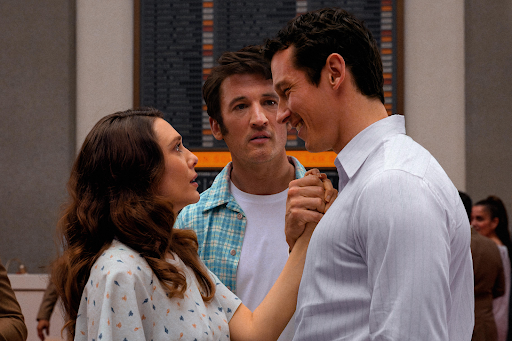
David Freyne’s Eternity (2025) is as excellent a film as it is an idea. Released on November 26, Eternity’s hook immediately drew me in, and I’m sure it did several others as well. The film follows an older couple entering the afterlife, played by Miles Teller and Elizabeth Olsen, whose relationship is put to the test when the wife’s long-deceased ex-lover, played by Callum Turner, reveals he was waiting for her all along.
Aside from its thought-provoking storyline, Eternity’s production clearly put immense care into each of its aspects. What could have been simple aesthetic choices, like production design, clearly had a lot of thought put into them, creating an afterlife that feels like a true community rather than a simple above-the-clouds heavenly landscape. The film’s afterlife setting is depicted as a brightly colored train station known as The Junction, where“afterlife guides” are designated to each person who can offer them different ways to spend the rest of eternity. Each eternity is advertised like a vacation, creating some humor in an otherwise emotional environment.
The score for Eternity was one of my favorite aspects of the film. David Fleming, who has gained popularity recently after scoring Superman (2025), uses recurring motifs for each relationship so masterfully that it completely recontextualizes the melodies depending on the emotion of the scene. Even for the simple world-building of the bustling afterlife train station, Fleming perfectly captures the environment with the right sound to accompany it.
Of course, a movie like Eternity could not have been so great without the performances of its actors. Miles Teller and Elizabeth Olsen, tasked with playing an older couple who suddenly find themselves young again (which the film explains by claiming everyone in the afterlife is restored to their happiest form), capture the cadence and mannerisms of a bickering married couple extremely well. Naturally, that aspect of their performances allows for humor since they look very different from how they sound, but they manage to balance it well with the intimate and emotional beats. Callum Turner, who plays the ex-lover, is first presented as the ideal man who never got a chance, but slowly begins to show his flaws and imperfections that prove his humanity. His performance really added to the central theme of giving up a potential relationship that was once lost in favor of a current, happy relationship. Da’Vine Joy Randolph, who plays an “afterlife guide,” adds humor to several scenes in the film, which was a surprise following her role as the emotional core of her previous film, The Holdovers (2023).
My favorite sequence in the film was one in which Olsen’s character constantly returns to a museum-like experience in which she revisits her past memories. Not only did the score elevate them, but the visuals and cinematography did so as well. The fact that the idea behind Eternity is so conceptual and original allows for some creative choices to be made. It also allowed for the messages behind the film to resonate, which I think Freyne conveyed perfectly.
Eternity is about so much more than people make it out to be. An example I can use to relate to this film is very similar: Materialists (2025) by Celine Song. Song’s previous film, Past Lives (2023), was met with critical acclaim, also being about the missed opportunity of a past relationship contextualized with a divide between their cultures. Materialists, however, was overall laughed off and forgotten. Materialists, like Eternity, involved a love triangle and was watered down by audiences to “poor guy vs. rich guy.” Yet Song’s critique of modern dating, including matchmaking and online dating, was overshadowed by the more marketable approach, that being “which A-list male actor will she choose?”
It’s not entirely the audiences’ fault that these kinds of films are received in this way, though. A month before Eternity’s release, distribution company A24 uploaded a YouTube video titled “Eternity | Miles Teller, Elizabeth Olsen and Callum Turner Solve Love Triangles | A24”. The video is a simple and fun marketing video in which the cast of Eternity debates some famous film and television love triangles. In no way do I condemn this kind of marketing, but I do recognize that it likely plays a factor in the type of audience it draws to a film. Is that a bad thing? Probably not, considering that any marketing that expands an audience is better for an original film. Still, it is worth it for audiences to reconsider how they view these types of films. I personally really loved the idea that it is okay to mourn a past relationship while still appreciating a current one, so long as you dedicate yourself to whomever you’re with. But if audiences can’t discern that theme, then they miss out on the experience the director intended.
I can’t help but feel a little bad for Eternity, seeing as the film put so much care into each aspect of it without disregarding its attention-grabbing hook, only to go completely unrecognized in terms of awards (although films like Sorry, Baby (2025) experienced the same treatment). A24’s emphasis on Marty Supreme (2025) for award season was likely a factor that caused Eternity to have to take a backseat, but I do worry that part of the reason it was so overlooked was the way many brushed it off as a simple love-triangle movie.
After I saw Eternity, a friend of mine who considered watching it asked me:
“Who does she get with in the end?” followed by the assertion, “That’s all I care about.”
There’s something that gives me a bad feeling about the way people have begun treating movies the same way a high school student might treat their assigned reading for class. Simply reading a plot summary or being told what happens in a film is so different from actually watching one, particularly because the film will actually evoke emotions that the director purposefully tries to make you feel.
Although condemnable, at least the high school student’s actions are oriented towards trying to raise their grades. Reading a plot summary is sacrificing entertainment for efficiency, which makes no logical sense. Perhaps one may be trying to find out about these movies for the sake of conversation, but in a social setting, that performativity can easily fall apart, and it will all have been for nothing. So just watch movies. Please.