

















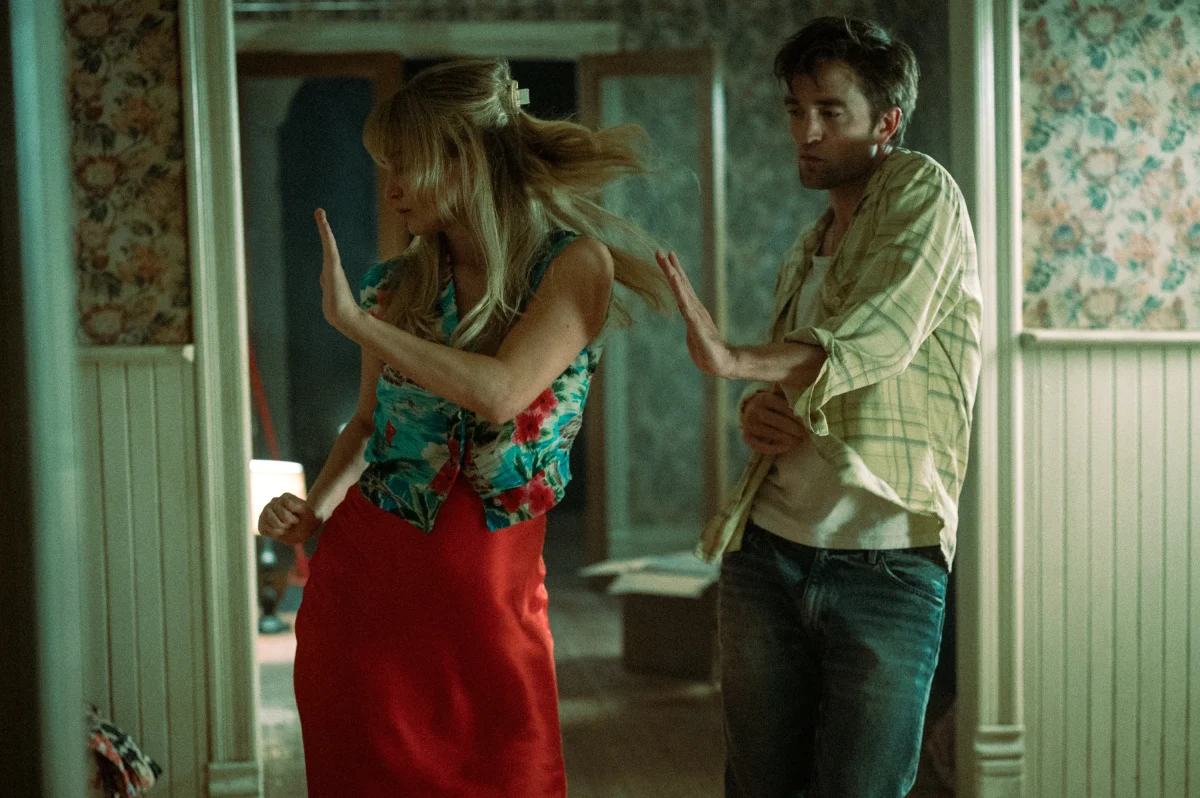
On November 7, Lynne Ramsay’s Die My Love (2025) was released domestically. Starring Jennifer Lawrence and Robert Pattinson, Die My Love tells the story of a new couple in town as they spiral into madness, mainly due to the mental state of Jennifer Lawrence’s character, Grace. Her role as a mother and wife suffocates her, resulting in several psychological episodes.
I visited my local AMC to see Die My Love alone, without seeing any reviews or reactions, which I generally find to be a good gauge to truly finding my own feelings about a film. Having only seen the trailer, I was completely open to seeing a particularly challenging or thought-provoking film, even one that some may view as pretentious. There were very few people in the theater, which further emphasized that Die My Love may be experimental in its presentation. Many fans, upon seeing the two lead stars, hoped for a lighthearted rom-com between Edward in Twilight (2008) and Katniss in The Hunger Games (2012), but the trailer and other promotional material alone emphasized that the actors would be continuing to stray from commercial films. I truly was open to a unique film that strayed from conventional storytelling, but I still left the theater somewhat disappointed in what I watched.
That’s not to say Die My Love was all bad. I particularly thought Lawrence and Pattinson gave great performances with what they were given, and the visuals in the film created a very effective aesthetic. The soundtrack and music in general created a great atmosphere for the story to live in. That being said, Die My Love suffers from an emphasis on what I like to call “those who know” filmmaking.
“Those who know” filmmaking is an original term I coined to describe when a filmmaker depicts an original experience, and while it may be an effective depiction for those who have gone through something similar, it doesn’t carry over the emotion or the feeling to audiences who are unfamiliar with the situation. Die My Love is about a writer feeling restricted by her domestic role and extreme sexual urges for her husband. This is obviously very far from anything I’ve experienced, but movies are constantly able to make audiences feel for situations they’ve never been in. Chances are you’ve never had to travel to space for decades and miss out on watching your children grow up, but we still get emotional watching Matthew McConaughey cry at videos of his children from space in Interstellar (2014).
But Die My Love takes a different approach. Although the atmosphere of the world is well built and the lead performances are great, the film misses that opportunity to truly resonate with unfamiliar audiences. In an ideal world, the actors’ performances would compensate for a lack of directorial direction, but even when Jennifer Lawrence dedicates herself to the role entirely, the unfamiliar audience misses out. Seeing Variety’s newest installment in their Actors on Actors YouTube series, a conversation between actor Leonardo DiCaprio and Lawrence herself, gives further insight on these ideas.
In the video, Lawrence recalls that the role was suggested to her by renowned director Martin Scorsese, who she and DiCaprio are confirmed to work with in the future. She admitted not understanding how the original book, which consisted of mostly internal dialogue, could be adapted into a film. She then notes that director Lynne Ramsay is a poet, a fact that explains certain nature sequences and symbolic situations. However, the poetic background of Lynne Ramsay is part of what I think caused the film to fall flat. Lawrence also recounts that Ramsay was very observational on set, taking a very hands-off approach after building the world. Poets are very observational, and typically describe what they see in depth. While an actor can dedicate themselves to a role, an observational standpoint that takes no direction only distances an audience from truly feeling what the character feels.
My unfamiliarity with the situation made the actions of characters feel extremely unpredictable, making for a strangely paced film. I was never able to see a clear line of thinking between Lawrence’s actions, making for a very confusing viewing experience. While some may target the film’s pretentiousness or style, I would argue that those aspects of Die My Love were stronger than its directing.
I don’t think Die My Love fell flat for me due to its attempt at “those who know” filmmaking. However, I do think that its reliance on the relatability alone rather than taking a directorial direction made it a worse watching experience. In many ways, the final sequence was a very great piece of filmmaking, but it felt like a type of abstract poetry where I, as a high-school junior who is unfamiliar with the feeling of restriction as a domestic housewife, have a number of different ways to explain it, whereas a domestic housewife may have stronger feelings and understanding of the sequence. I do believe that Ramsay is a talented director based on what I’ve seen from the writing and atmosphere, but I feel as if a more evident directorial direction on Ramsay’s part could have strengthened the film.
It may seem like I take a firm stance against “those who know” filmmaking, but some of my favorite films have fallen into this category. I do believe that certain types of “those who know” filmmaking can be effective. Charlie Kaufman’s I’m Thinking of Ending Things (2020), which I will admit is more pretentious than Die My Love, is one of my favorite films of all time, despite it being completely unrelatable and almost incomprehensible until certain details are revealed to the viewer. Even still, it remains unrelatable for the most part. Its effectiveness in emotion comes from its strong directorial stance on Kaufman’s part. Ari Aster’s Beau Is Afraid (2023) is another one of my favorite films, and most of its plot points are abstract and symbolic. The paranoia Beau is Afraid evokes in its audience makes it an extremely emotional experience for me, despite the fact that my mother is not evil and I operate just fine. It is not the experience or relatability that brings emotion to the audience. Rather, it is a director’s vision that does so.