



















Imagine a world where AI (artificial intelligence) dominated gaming. A world where the future seems exciting, but concerning at the same time. AI is used to enhance games, but disregards human creativity. Seems familiar? Well, that might be the world we’re living in today!
Tech manufacturing company Micron is starting to shut down their consumer brand, Crucial, and sell all their RAM (random-access memory) to AI companies for AI data centers across America. When this news got out, content creators and gamers reacted with outrage, arguing that gaming devices require RAM to operate. If there were no RAM, the prices of those gaming devices would spike to an all-time high due to the extra effort needed. They’re also the top brand for gamers. However, Micron argued that selling their RAM to AI companies would be a stronger cause to support and would also benefit their economic interests.
Micron Technology Executive Vice President and Chief Business Officer, Sumit Sadana, stated that AI has seen a greater demand for RAM, and Micron made the difficult decision to sell their Crucial RAM to “improve supply and support for [Micron’s] larger, strategic customers in faster-growing segments.” Sadana argued that selling RAM to gamers and companies that specialize in that field would not be as important as selling it to higher-value consumers, such as AI companies. This controversial take by Sadana sparked further drama in the gaming world.
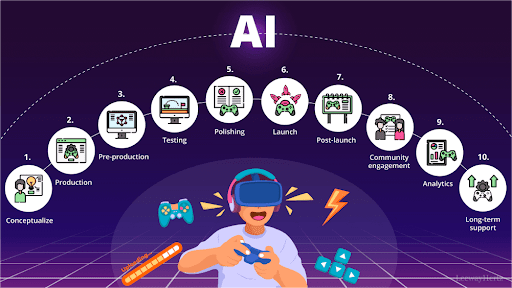
That’s not the only problem with AI in gaming. It has also been present in the development of the games themselves. A Google Cloud survey found that nearly 9 out of 10 video game developers used AI agents for cumulative and repetitive tasks. On one hand, AI can help with minor inconveniences during the creation of these games, but it also poses a significant risk to developers. Since AI can do these tasks for developers, why would there be a developer in the first place? This increases the risk that developers will lose their jobs, and it would not look good to the public, since there has been a strike before. All this backlash will be one step closer to destroying the gaming industry if nothing’s done about it.
AI in the development of games is already bad, but it gets worse when it’s in the game. In 2025, 25% of Steam games released were reported to use generative AI, a 700% increase from last year. This plays an important role in the gaming industry because it promotes “AI-slop”. The public criticizes “AI-slop” as low-effort content to grab attention, and when a lot of games have that, gamers will show that same view, but there will be higher stakes. These games will cause “AI-slop” to be more mainstream because, as long as these games get popular, most game studios don’t care about public opinion; therefore, more chaos in the gaming world.
AI has had a damaging impact on video games, and there’s a massive debate on what this means for the future of gaming. What’s going to happen next? Is gaming only gonna be remembered for AI? Will this be the end of gaming? Well, there’s still hope.
The biggest problem is the RAM, and to address this issue, Micron needs to distribute the RAM more evenly. RAM might be important to AI companies, but that doesn’t mean they should exclude gamers. One thing Micron has to know is that most gamers aren’t millionaires, so they can’t pay the high price for gaming devices when they remove RAM. They want to make money by selling RAM to AI companies, and that’s a goal for any company in the world. By selling RAM equally to both sides, they are making bank and satisfying the players.
This may be a bit controversial, but I think AI should be used in the development of games. It shouldn’t be used for big purposes, such as the story and the gameplay, which would replace developers. It should be used for minor inconveniences, since this could save time and money on the creation of a game and would also cut developers some slack. However, AI should never be inside a game. Most gamers don’t like the idea of “AI-slop” in video games, and it has been known to cause more drama outside of gaming. If game studios don’t use AI in their games, they would avoid a ton of backlash.
Now, will game studios and Micron listen to this solution? It’s unlikely they would even come across this article from a random high school newspaper. They could, but for now, we’ll have to hope because there’s a chance that gaming isn’t exactly over.