
















Chloé Zhao’s Hamnet (2025), released on November 26, follows the story of Agnes, the wife of William Shakespeare, and the death of their eleven-year-old son, Hamnet Shakespeare. Hamnet is an adaptation of author Maggie O’Farrell’s 2020 novel of the same title, which used historical events in the life of William Shakespeare as a guideline for the plot. That being said, the filling in of the blanks between events, as well as the events themselves, are masterfully written and translate extremely well to the screen.
Starring actor Paul Mescal as Shakespeare and actress Jessie Buckley as Agnes, Hamnet follows the pair from the moment they meet to the first performance of Shakespeare’s Hamlet (which was a name interchangeable with “Hamnet” during the period). Director Chloé Zhao puts immense consideration into the film in a way that makes you care so intensely for her characters and everything that happens to them. Before Hamnet, Zhao directed Marvel Studios’ Eternals (2021), following an ensemble cast of immortal superhumans and their lives protecting the Earth. Eternals was critically and financially regarded as a failure by Marvel’s standards, particularly due to the large ensemble of original characters that did not draw in as much of Marvel’s audience as they may have hoped.
After seeing Hamnet, it is clear that Chloé Zhao has redeemed herself as a director simply by slowing down the ambition of the project and focusing on a select few important characters. Hamnet is a very slow-paced film, but there was not a second in the theater where I felt like looking away. Each frame was beautifully executed, depicting exactly what was necessary for the story, and it felt like the story never slowed down. Rather, it took its time to reveal itself when necessary.
What I found particularly interesting about Hamnet was the lack of information given to the audience in regards to the fact that we were watching a story about such an important historical figure and his wife. William Shakespeare is revealed simply as a tutor of Latin to local young boys, while Agnes is solely depicted as a woman of nature. I also find it notable that she is referred to as Agnes rather than her more recognizable name of Anne Hathaway (unrelated to the popular actress), despite only being referred to as Agnes in her father’s will (Agnes and “Annes” were interchangeable names at the time as well, similar to Hamlet and Hamnet, but the point still stands). Upon further investigation, I found that O’Farrell’s novel followed a similar pattern, never referring to Shakespeare by his last name, often calling him the “latin tutor” or “husband.” This was likely an intentional choice by both O’Farrell and Zhao, as stripping the figures of their reputable names leaves the audience with simply human characters to connect with. This decision works especially for those who go in blind, unaware that Hamnet is about Shakespeare at all. Still, the film eventually makes direct references to Shakespeare and the play Hamlet for the sake of the story, and it is fun to catch subtle references to Shakespeare’s life earlier in the film.
The setup and payoff principles used in Hamnet work much in its favor, in part due to the slow pacing, allowing for every line to be emphasized. An example of this principle in practice is just before Hamnet dies of the plague instead of his twin sister. Prior to the twins’ falling ill, Agnes uses her pet hawk’s death as a way of teaching her children to search for the hawk’s spirit in the skies, whistling up at it to tell it to carry their wishes. Following Hamnet’s death, he is depicted in a scene with a painted forest background, which is later revealed to be the setting for the performance of Hamlet, indicating that Hamnet lives on within his father’s work. In this scene, Hamnet heartbreakingly uses the whistle as a final effort to find help from a source close to his mother.
Another setup and payoff example in Hamnet is the reference to the tale of Orpheus and Eurydice, an ancient Greek tale where lovers in Hades’ underworld were forced to try and escape, with the catch being that Orpheus was not allowed to communicate with Eurydice or to turn around and confirm her presence. The tragic tale ends with Orpheus turning around at the gates back to life, only to have Eurydice vanish at the last moment. Shakespeare, in Hamnet, recites the tale to Agnes upon one of their first meetings. At the end of the film, during a production of Hamlet, Agnes yells to Shakespeare, urging him to turn around and look at her, which he does. Yet, this does not particularly evoke the sense of deeply rooted love that Orpheus and Eurydice do. Instead, it serves as a way of showing Agnes begging Shakespeare to reveal his true feelings of grief, which he does through his writing.
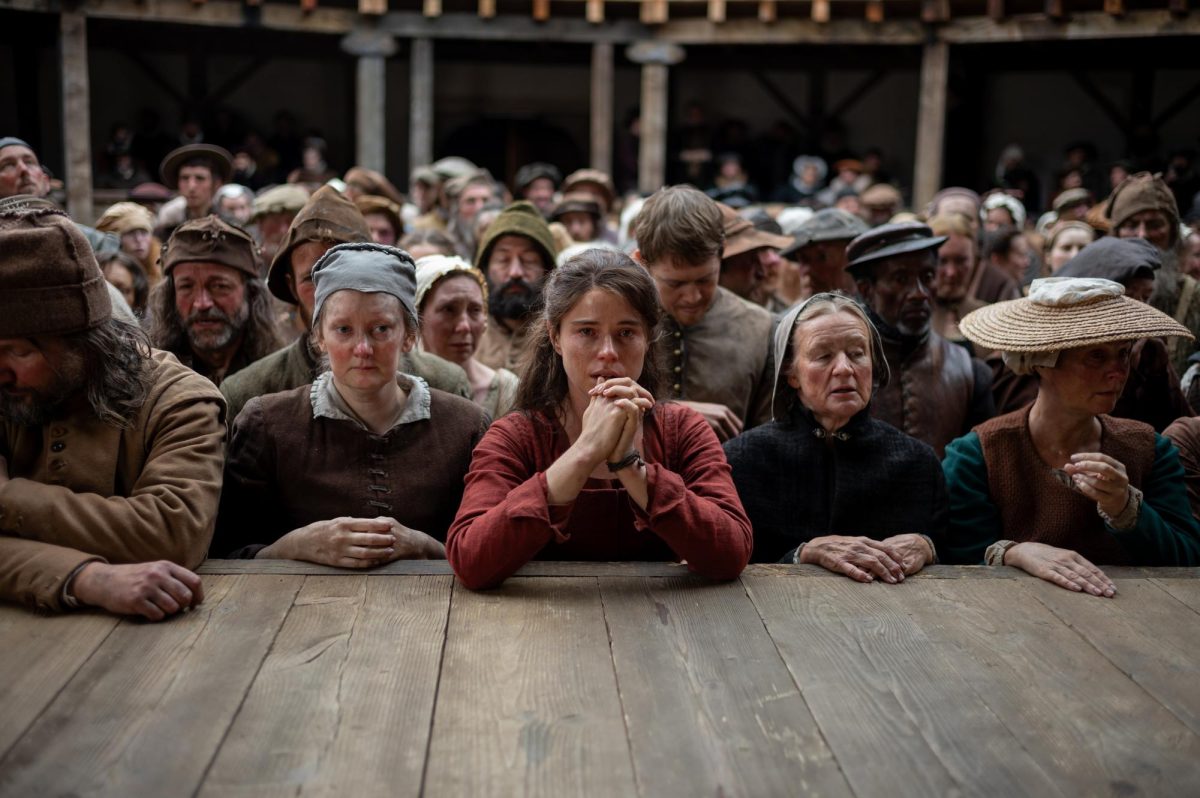
The final scene of the film is one of the best scenes to come out of any movie in 2025. It begins with Agnes hearing of her husband’s new play, a tragedy called Hamlet. Of course, she attends the performance, making her way to the front of the audience. Agnes, dressed in bright red to contrast those around her, makes a number of remarks toward her husband and the events of the play itself. I’ll admit some of her outbursts cause a sense of secondhand embarrassment, but it dissipates regardless, since audience members at the time were encouraged to involve themselves with dramatic reactions to the events of the plays. The scene of the stage is intercut with Shakespeare backstage, painted white to represent the ghost of Hamlet’s father. His hesitation and lack of reactions throughout the performance are essential to the idea that his grief is exclusively expressed through his work. One particular shot, seemingly depicting Shakespeare’s point of view from backstage, is especially eye-catching. Still, the most impactful moment of the scene is when the actor playing Hamlet reaches out before his death, and the performance almost comes to a pause when Agnes reaches back out to him. After getting over her frustration and no longer being upset with the play, she realizes the value in what her husband has created. Then, the value is further emphasized by the rest of the audience as they join Agnes in reaching their hands out back at Hamlet.
If it hasn’t been made clear already, I highly recommend Hamnet. A film with as much care put into it as Hamnet is almost difficult to execute wrongly, especially since it truly takes the time it needs to tell its story. Hamnet’s compelling performances and strong directorial stance elevate it to a completely new level, to the point where I was left stunned in my seat following the screening, half-tempted to ask the stranger next to me if they felt the same way after seeing such an emotional film. Hamnet evokes emotions in its audience in the traditional way: with both complex characters and the necessary time to get to know them.